

The AI boom is increasingly becoming a capital-expenditure story.
Baseline estimates now point to roughly $7.6 trillion of AI-related CapEx between 2026 and 2031, spanning compute, data centers, networking, and power infrastructure.
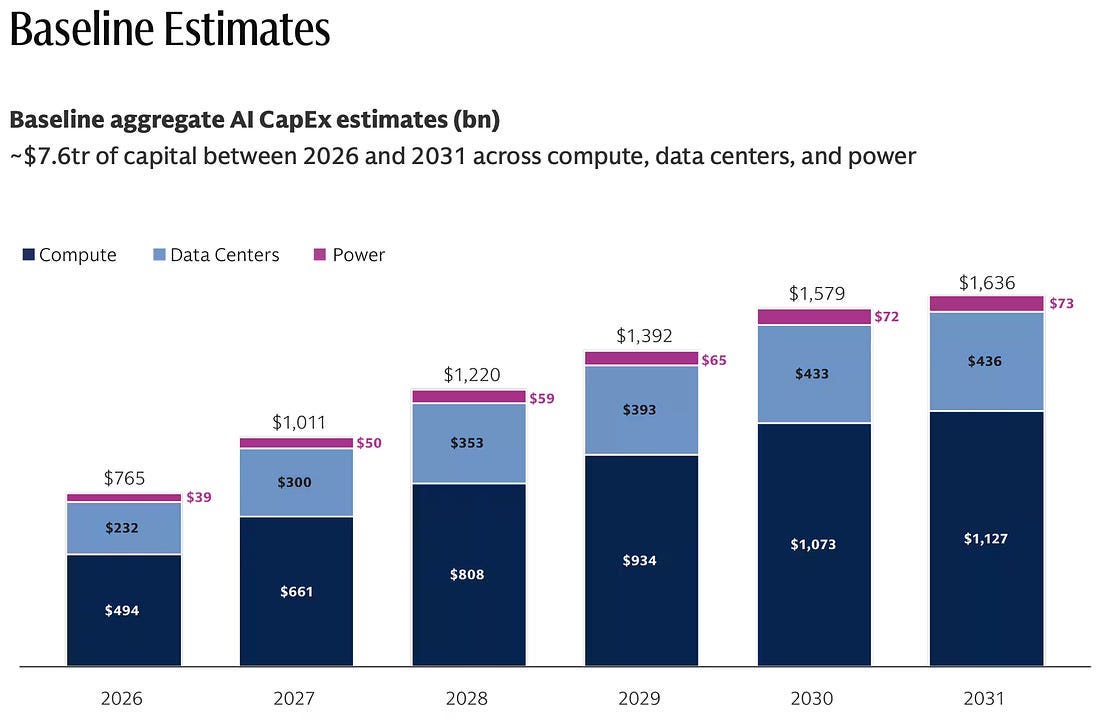
Annual spending alone could rise from roughly $765 billion in 2026 to more than $1.6 trillion by 2031.
Those numbers are impressive.
But as investors, the more interesting question is not how big they are.
It is what they mean.
Because the largest technology companies are no longer only selling software and scaling digital products at very low marginal costs.
They are buying GPUs.
Building data centers.
Securing energy.
Expanding networks.
And committing enormous amounts of capital to physical infrastructure.
AI is starting to look much more like an industrial business.
And that changes the investment equation.
Growth is not enough
I recently watched this interview with Aswath Damodaran, and one idea stayed with me:
“Any company can be a good investment at the right price. And any company can be a bad investment at the wrong price.”
It sounds obvious.
Yet it is probably one of the mistakes investors make most often.
We find an extraordinary company.
A huge market.
A technology that could change the world.
Impressive growth.
And slowly, almost without noticing, we stop asking how much we are paying for it.
But a great company and a great investment are not the same thing.
That distinction matters even more in AI.
It is easy to say: “AI is going to be huge.”
It is much harder to say: “This specific company will create significant value for its shareholders from AI.”
Between those two statements sits almost everything that matters.
How much of the market can the company capture?
How much pricing power will it have?
What will margins look like?
How much competition will enter?
How much capital will be required?
And what return will the company earn on that capital?
A huge TAM is only the beginning of the analysis.
Not the end.
AI is becoming more capital intensive
For years, many of the world’s largest technology businesses had an attractive economic characteristic.
They could grow without needing an equivalent increase in physical capital.
Software is powerful partly because the next customer often costs very little to serve.
AI infrastructure changes that equation.
Training and running large models requires chips, servers, data centers, networking equipment, cooling systems, and huge amounts of electricity.
These are real assets.
And they are expensive.
That means investors may need to start thinking about some AI companies less like pure software businesses and more like capital-intensive industrial companies.
The question is no longer only: How fast can revenue grow?
It is also: How much capital needs to be invested to produce that growth?
That distinction matters.
A company can grow revenue quickly and still create very little shareholder value if generating that growth requires enormous amounts of incremental capital at mediocre returns.
Growth only creates value when the return on the capital invested to generate that growth is attractive.
This is why I think ROIC will become increasingly important in analyzing AI.
Revenue growth tells us how quickly the business is getting bigger.
ROIC tells us something more important: whether getting bigger is actually creating value.
The hidden question: how long will the assets last?
There is another issue.
Asset life.
A data center built today may remain physically usable for many years.
The accounting statements may depreciate the equipment over a relatively long period.
But economic life and accounting life are not always the same thing.
Especially in technology.
A GPU does not need to stop working to become economically obsolete.
A new generation of hardware may simply offer much better performance, lower energy consumption, or better economics.
If that happens faster than expected, companies may need to reinvest sooner than investors assume.
And that has major consequences.
Imagine a company spending tens of billions of dollars on AI infrastructure.
If those assets remain economically productive for a long time and generate high returns, that CapEx may create enormous value.
But if hardware needs constant replacement while competition pushes down prices and margins, the economics look very different.
This is why headline EPS may not tell us enough.
Even free cash flow needs context when growth CapEx becomes extremely large.
We need to understand the reinvestment requirements behind the growth.
Two companies can report similar revenue growth while producing completely different outcomes for shareholders.
One may require very little incremental capital.
The other may need to reinvest almost everything it earns just to remain competitive.
Same growth.
Very different economics.
You can be right about the trend and wrong about the investment
This is one of the most useful lessons in investing.
You can be completely right about the future of an industry and still lose money investing in it.
In 1999, you could have been right about the internet.
The internet did change the world.
Probably even more than many people expected.
That did not mean every internet company was a good investment.
The same can be true with AI.
AI can become one of the most important technologies of our lifetime.
The market can grow enormously.
Some companies can become much larger than they are today.
And at the same time, many companies can destroy capital.
These things are not contradictory.
The problem is that history makes the winners look obvious.
We see Amazon.
We forget the hundreds of companies that disappeared.
We see Nvidia’s past returns and think the opportunity should have been easy to recognize.
It rarely was.
That is survivorship bias.
We see the tree that became an oak but we forget all the seeds that never grew.
From regret to FOMO
Damodaran makes another interesting point.
Before FOMO — Fear Of Missing Out — there is often something else: ROMO: Regret Of Missing Out.
You watched Bitcoin rise without owning it.
You missed Nvidia.
You watched Amazon compound for years.
Then another exciting opportunity appears.
This time, you tell yourself, you will not miss it.
The internal logic changes from:
“What return can I reasonably expect at this price?”
to:
“I cannot afford to miss the next Amazon.”
That is a dangerous shift.
Because price slowly becomes secondary.
You are no longer buying because the expected value looks attractive.
You are buying insurance against future regret.
Those are very different decisions.
An investor should be able to say:
This could become one of the best companies in the world, and I may still decide not to own it.
Not because the business is bad.
Not because the technology is unimportant.
But because the price may leave no margin for error.
The higher the expectations embedded in the price, the more things need to go right.
Stories matter. But they eventually need to become numbers.
Investors often fall into two camps.
One group looks almost entirely at numbers: multiples, margins, earnings, cash flow.
The other focuses heavily on the story: TAM, technology, visionary founders, adoption curves, future growth.
Both approaches can miss something important.
Numbers without a story can underestimate change.
Stories without numbers can justify almost anything.
A serious investment process needs both.
The story has to eventually become numbers.
Otherwise, it is still only a story.
This does not mean we need to predict the future perfectly.
We can’t.
The real purpose of valuation is not to calculate exactly what a stock will trade at five years from now.
It is to understand what the current price already assumes.
If today’s valuation requires a company to capture a huge percentage of a trillion-dollar market, maintain extraordinary margins, reinvest at high returns, and defend its position against aggressive competition for decades, that tells us something.
It tells us what we are betting on.
And then we can ask the question that matters: how reasonable are those expectations?
Value investing was never about low multiples
This is also why I think value investing needs to be understood correctly.
For decades, investors often associated “value” with a very specific kind of company:
low P/E;
low price-to-book;
tangible assets;
slow growth;
simple businesses.
But those characteristics are not the underlying principle.
The principle is much simpler:
Buy something for less than it is worth.
A bank trading below book value can be expensive such as technology company trading at a high multiple can be cheap.
It depends on the future cash flows, the risks involved, the capital required to generate them, and the expectations already reflected in the price.
Modern companies make this analysis harder because much of their economic value comes from things traditional accounting does not capture particularly well: software, research and development, intellectual property, networks, brands, data.
But the fundamental question has not changed.
What am I getting, and what am I paying?
The AI metrics I think matter more now
This is where the AI investment debate becomes particularly interesting.
Revenue growth will still matter.
Margins will still matter.
EPS will still matter.
But they may not be enough.
I increasingly want to understand four things.
1. Incremental ROIC
For every additional dollar invested into AI infrastructure, how much additional operating profit can eventually be generated?
2. Reinvestment intensity
How much capital must the company continually reinvest to maintain its competitive position?
3. Economic asset life
How long will today’s chips, servers, and data centers remain economically productive?
4. Expectations embedded in the price
How much future success are investors already paying for?
This brings everything back to the framework we use when studying investments:
Quality. Price. Odds. Sizing.
Quality: Is this a business worth owning?
Price: Am I being paid for the risks I am taking?
Odds: What has to happen for today’s valuation to work?
Sizing: How much capital does the uncertainty justify?
AI does not make those questions obsolete. It makes them more important.
The hardest part: changing your mind
There is one final lesson from the Damodaran interview that matters more than any valuation model.
We will be wrong. Not occasionally. Regularly.
That is part of investing.
The real problem is not buying something that later falls.
The problem starts when our identity becomes attached to the decision.
We stop updating the thesis.
We defend the position.
We search for evidence that confirms what we already believe.
We ignore evidence that contradicts us.
Sometimes we double down simply because admitting a mistake has become psychologically expensive.
But the market does not care what we believed six months ago.
The only relevant question is:
Given what I know today, would I still make the same decision?
AI will produce extraordinary companies. It will probably also produce extraordinary capital destruction.
Both can be true.
The job of the investor is not to predict which technology will change the world.
It is to understand the economics behind that change.