

Booking Holdings is trading at one of its lowest valuations in years.
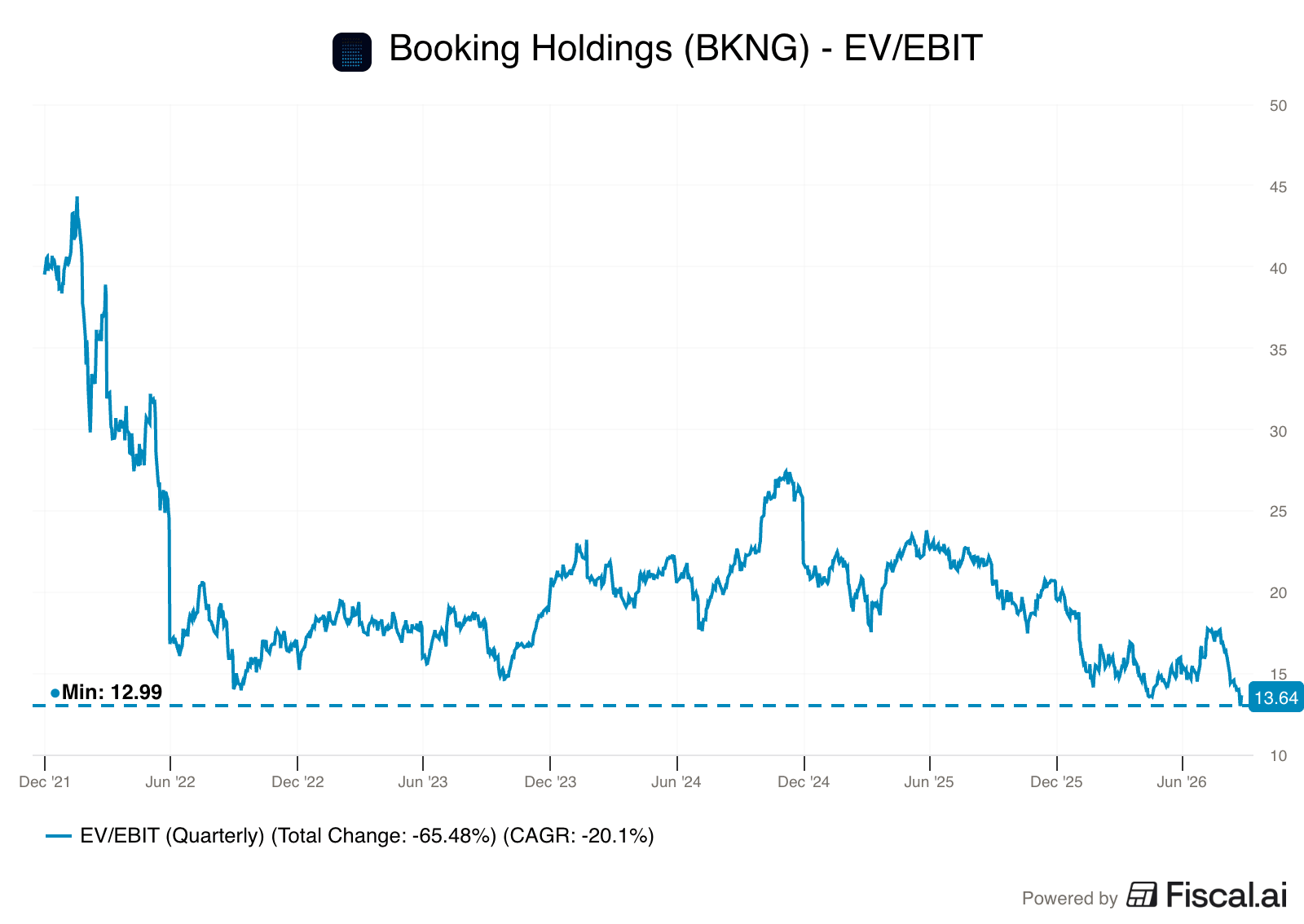
And it has been at the center of the recent “agent-pocalypse” debate.
Booking is the parent company behind Booking.com, Priceline, KAYAK, Agoda, and OpenTable. At its core, the business sits between travelers looking for somewhere to stay and properties looking for demand.
That position has historically created a powerful network effect.
Travelers use Booking because it aggregates enormous supply in one place.
Properties list on Booking because Booking brings them customers.
More demand attracts more supply.
More supply makes the platform more useful.
The concern is that AI agents could weaken that loop.
Meta launched Muse in September, a personal AI agent capable of browsing the web and handling tasks including travel booking on a user’s behalf.
If consumers stop searching through Booking.com and instead tell an AI agent, “Find me the best hotel in Rome for these dates,” the agent may have little reason to start its search inside an OTA.
It could search across Booking, hotel websites, Google, and other sources before completing the transaction wherever it finds the best combination of price and availability.
That would move part of the customer relationship away from Booking and toward the agent.
It is a legitimate risk.
But there is a big difference between changing the interface through which travel is discovered and eliminating the economic value Booking provides underneath it.
That distinction is where the case gets interesting.
A falling stock is not automatically a cheap stock.
A low multiple is not automatically a mispricing.
But when a high-return, cash-generative business is being repriced around a plausible but still uncertain structural threat, it becomes worth studying.
Why it’s worth watching
Booking combines several characteristics we look for:
a strong marketplace;
very high returns on capital;
an asset-light model;
large free cash flow;
and meaningful capital returns through buybacks.
The market’s concern is not primarily whether Booking is a good business today.
It is whether AI changes the economics of that business tomorrow.
What it does
Booking Holdings operates one of the world’s largest online travel ecosystems through brands including Booking.com, Agoda, Priceline, KAYAK, and OpenTable.
It connects travelers with hotels, apartments, flights, rental cars, restaurants, and other travel services across more than 220 countries and territories.
Booking earns money mainly through two models.
In the agency model, the travel provider completes the transaction and Booking earns a commission.
In the merchant model, Booking facilitates more of the transaction itself and collects payment from the traveler.
Merchant revenue has become increasingly important. In Q2 2026, merchant revenue was roughly $5.1 billion versus about $1.9 billion from the agency model.
The business requires relatively little physical capital.
In the first half of 2026, Booking generated about $6.93 billion of operating cash flow and $6.75 billion of free cash flow while spending only $183 million on capital expenditures.
This is fundamentally a marketplace and distribution business.
The asset is the network.
Why it may be mispriced
The market is asking whether AI agents make traditional online travel agencies less important.
The concern makes sense.
Historically, Booking owned an important part of the customer journey.
A traveler searched for a hotel.
Booking aggregated the available inventory.
Booking ranked the choices.
Booking handled reviews, pricing, payment, and increasingly other parts of the trip.
An AI agent could sit above that entire process.
Instead of browsing Booking.com, the traveler simply gives the agent an objective.
The agent does the searching.
That potentially weakens Booking’s position as the interface between demand and supply.
But that does not necessarily mean it eliminates Booking’s position as the infrastructure behind the transaction.
Booking has spent decades aggregating fragmented global hotel supply, alternative accommodations, availability, pricing, reviews, payments, and customer demand.
For a small independent hotel, the problem is not simply putting up a website but consistently finding global customers.
Booking solves that problem.
That is why the real question is not: “Will AI agents book hotels?”
They almost certainly will.
The better question is: “When an AI agent books a hotel, who provides the inventory, availability, trust, payment infrastructure, and transaction?”
If Booking remains an efficient answer to that question, AI may change the front end without destroying the economics underneath it.
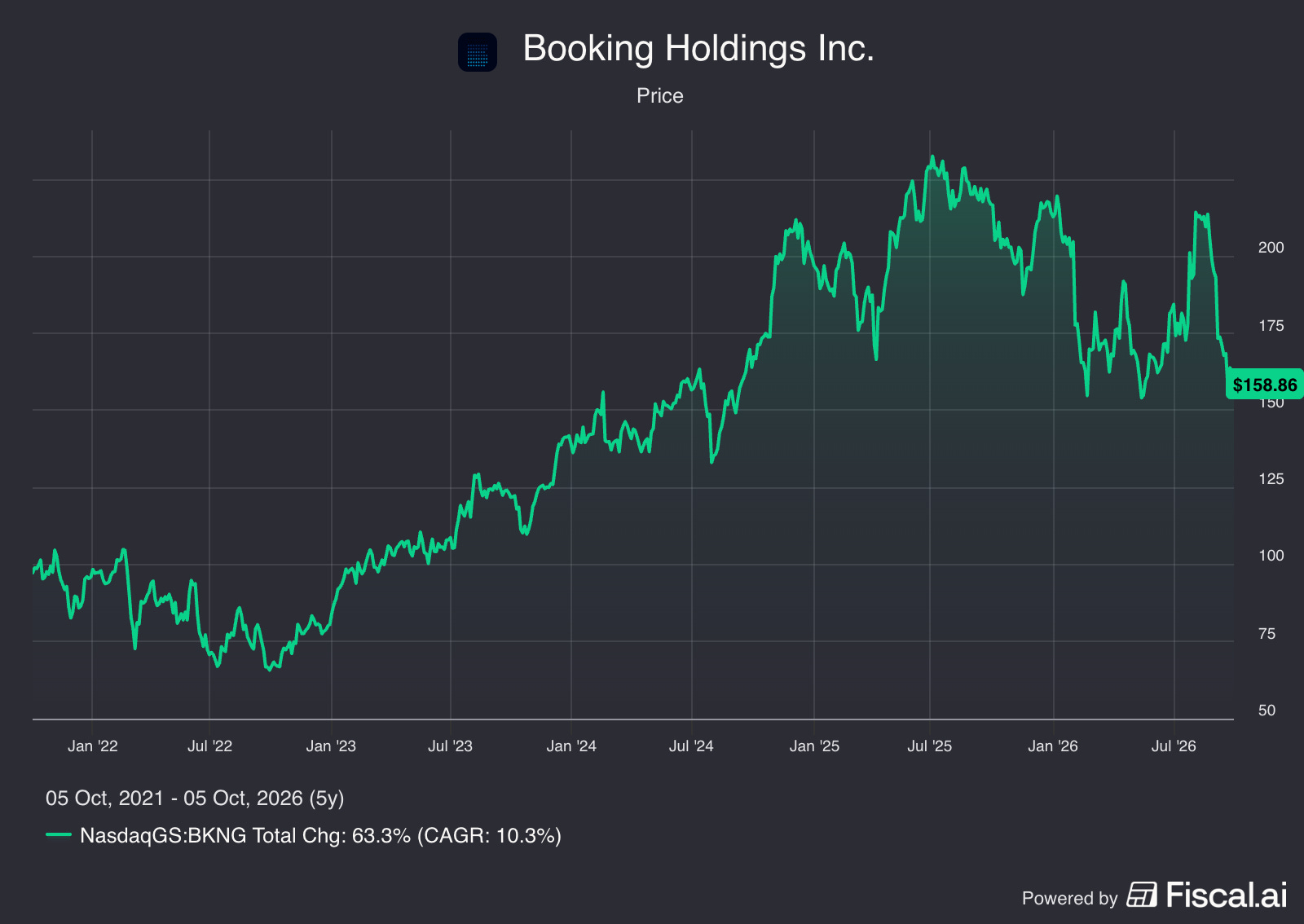
Meanwhile, the current valuation already assumes a meaningful amount of caution.
Our normalized estimate is roughly $12–13 of free cash flow per share.
At $158.86, that implies approximately 12.6x normalized free cash flow, or close to an 8% free-cash-flow yield.
That is unusual for a business with Booking’s economics.
The company continues to generate operating margins above 30%, extremely high returns on capital, and substantial free cash flow.
And the operating business has not collapsed. In Q2 2026 room nights grew 5%, gross bookings grew 9%, revenue grew 8%, adjusted EBITDA grew 9%, and free cash flow grew 16%.
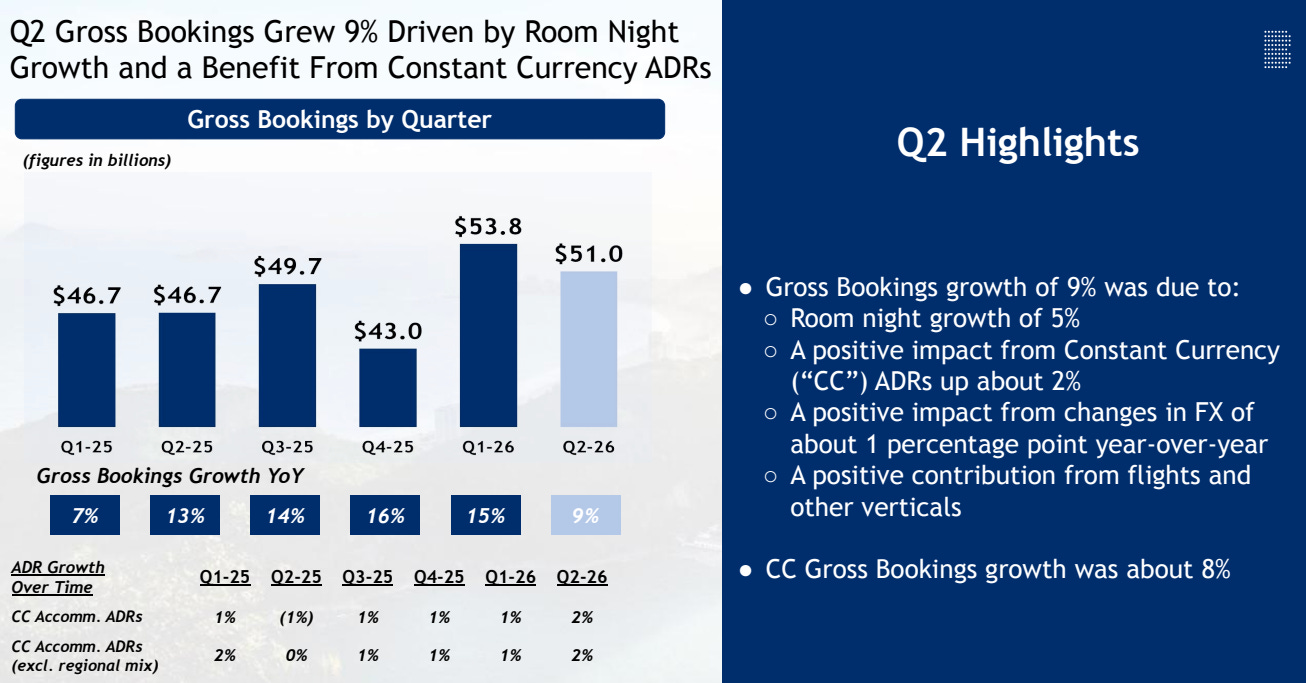
The market is therefore not pricing a broken business.
It appears to be pricing the possibility that the business becomes less valuable in the future.
That is the mispricing question.
What matters
Four things matter from here.
1. Does Booking retain control of demand?
The most important metric may increasingly be direct traffic. If travelers continue to open the Booking app or visit Booking directly, its bargaining position remains strong.
Booking’s B2C direct mix is currently around the mid-60% range, while the mobile app represents a high-50% share of bookings. Genius Level 2 and Level 3 users are also around the high-50% range. Those numbers matter because a loyal user is harder for a new interface to disintermediate than traffic purchased from Google. If direct engagement starts declining structurally, the AI thesis becomes much more serious.
2. Can the network effect survive a new interface?
Booking’s moat depends on liquidity.
More demand attracts more properties.
More properties create more choice.
More choice attracts more demand.
The key question is whether an AI agent reduces the value of that aggregated liquidity or simply becomes another way to access it. If agents still need Booking’s inventory and infrastructure, the moat may evolve rather than disappear. If they bypass Booking entirely, it weakens.
3. Can free cash flow per share keep compounding?
Booking does not need explosive revenue growth to create value. The company already produces enormous cash flow and returns much of it through share repurchases.
In Q2 2026 alone, Booking repurchased approximately $3.7 billion of stock, with another $14.5 billion remaining under its authorization. At attractive valuations, those buybacks can materially increase the free cash flow belonging to each remaining share.
That makes FCF per share, rather than headline revenue growth, one of the most useful metrics to follow.
4. What happens to customer acquisition costs?
Booking still spends heavily on performance marketing.
Marketing expense was approximately $2.37 billion in Q2 alone.
If AI and search platforms become stronger gatekeepers, Booking could be forced to pay more to acquire the same customer.
The moat does not need to disappear for the economics to deteriorate.
A persistent rise in customer acquisition cost would be enough.
The risk
The strongest bear case is not that Booking disappears, but that Booking remains a profitable company but becomes a less valuable intermediary.
Imagine the world five years from now.
Consumers increasingly begin travel searches through AI agents.
Those agents control the customer interface.
Hotels gain more ways to reach travelers directly.
Booking becomes one of several inventory providers rather than the destination where the journey begins.
Customer acquisition gets more expensive.
Suppliers gain bargaining power.
Take rates compress.
Room-night growth slows toward low single digits.
Booking is still large.
Still profitable.
Still generating cash.
But the market now views it as a mature distribution utility rather than a high-quality network business.
That is enough to compress the multiple materially.
The business does not need to fail for the thesis to fail.
The moat only needs to become less valuable.
Where we stand
Status
Portfolio Candidate
Fair Value
$180–$260
Central Fair Value
~$225
Margin Of Safety
~30%
Buy Zone
≤ $170-$190
Expected CAGR — Base Case
~17% over five years, before the small dividend
Thesis
The market appears to be pricing Booking as if growth will slow materially and its historical moat will become less valuable. Our base case does not require the old Booking: it assumes normalized free cash flow per share of approximately $12.6 today grows around 9% annually over five years.
That gets us to roughly $19.5 of free cash flow per share in 2031. At an 18x terminal multiple, that would imply a value around $350 per share in five years, equivalent to an estimated annualized return of roughly 17% from the reference price.
The bottom line
Booking is interesting because the market is trying to price a threat whose long-term economics are still unclear. AI agents may change how consumers discover and purchase travel. That part seems increasingly likely.
What is much less certain is whether they destroy Booking’s network effect or simply create a new interface on top of it.
At roughly 12–13x normalized free cash flow, the market is giving us a very different proposition from the one investors faced when Booking traded at a premium multiple.
The business does not need to remain untouched. It needs to remain useful.
That is what we are watching.
See the full research process 🚀
This case study is only the surface.
The Mispriced Pro gives you access to the full research process behind how we find, rank, monitor, and size opportunities.
Best Buys — our monthly shortlist of the highest-ranked opportunities across quality, valuation, and expected payoff.
Research Notes — focused research published every week, including fair values, research entry zones, scenarios, risks, and thesis updates.
Mispriced Portfolio — full access to current holdings, weights, performance, changes, and the research behind each position.
You can currently save more than 30% with the annual plan:
Until next time,
Luca