

Gold creates an interesting analytical problem today.
The strategic thesis has not materially deteriorated.
Debt remains high. Money supply remains elevated. Central-bank demand is still strong. Gold continues to behave like a monetary asset in an environment where confidence in fiat currencies and fiscal discipline remains an open question.
But the investment setup has changed.
Higher real yields increase the opportunity cost of owning an asset that produces no cash flow. At the same time, the higher gold price leaves less room for error.
The result is a useful distinction:
The thesis can remain intact while the price becomes less attractive.
That is where gold sits today.
1. The setup: structural strength, weaker asymmetry
The most important change since our previous review is not inflation, the dollar, or the Federal Reserve balance sheet.
It is real yields.
The U.S. 10-year Treasury yield has moved above 5%, while the 10-year real yield has reached 2.615%.
Historically, that is a difficult environment for gold.
Yet gold has not corrected materially.
That resilience is significant.
It suggests that structural monetary demand remains strong enough to offset part of the pressure coming from higher real rates.
Central banks remain an important part of that support. The World Gold Council data cited in our model shows 289 tonnes of central-bank purchases in Q2 2026.
But there is another side to the story.
Gold ETF flows were approximately -44.8 tonnes in Q2.
Financial demand is therefore not confirming a fully developed bullish scenario.
The picture is mixed: structural demand remains strong, but financial conditions have become less supportive.
2. The Gold Thesis
The strategic gold thesis remains intact.
The asset continues to provide exposure to several long-duration monetary risks: high sovereign debt, persistent fiscal deficits, elevated money supply, currency debasement risk and continued reserve diversification by central banks.
None of those variables has changed enough to invalidate the thesis.
What has changed is the tactical setup.
Gold is now more expensive while real yields are higher.
The underlying asset has not become worse.
The price-to-risk relationship has.
Mispriced Analysis
The market may still be underestimating the long-term consequences of fiscal stress and reserve diversification.
That remains the central bullish argument.
But today’s price already reflects more of that thesis.
Gold’s estimated market capitalization has increased from roughly $28.6 trillion to $30.0 trillion, while U.S. M2 has remained around $23.2 trillion.
That moves the Gold/M2 ratio from approximately 1.23x to 1.29x.
In other words, gold has become roughly 5% more expensive relative to M2 since the previous review.
At the same time, higher real yields reduce our fair-value assumptions.
Our updated scenarios are:
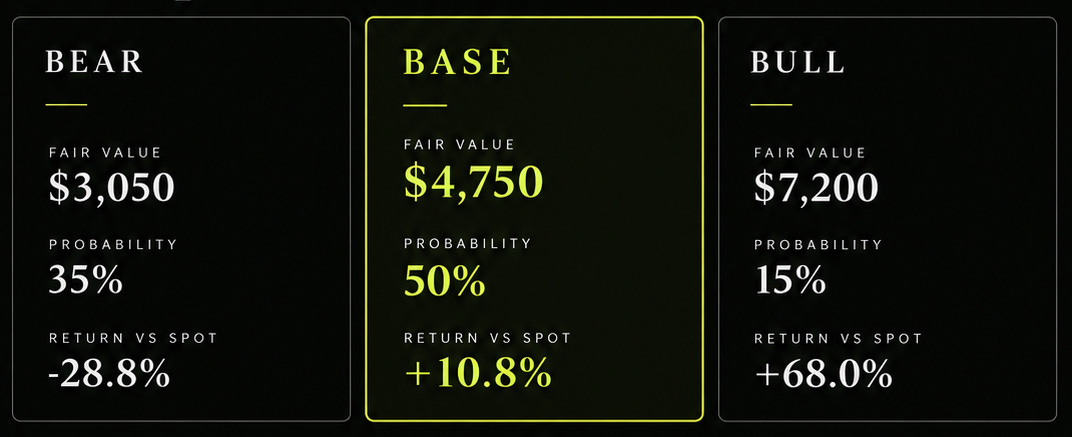
The base case remains above the current price.
But the asymmetry is no longer particularly attractive.
The probability-weighted expected value is approximately +5.5% in total.
Spread over a three- to five-year horizon, that falls to roughly 1%–2% annualized.
Under our framework, that is below the return hurdle required for new capital.
The important point is therefore not that gold is “overvalued.”
It is that the expected payoff at today’s price is too small relative to the uncertainty and downside.
Our View
Thesis status: INTACT, tactically weakened
Current price: ~$4,286
Attractive entry zone: below ~$4,100
Higher-conviction entry zone: below ~$3,750
Base scenario: $4,750
Bear / Base / Bull: $3,050 / $4,750 / $7,200
Probabilities: 35% / 50% / 15%
Sizing score: 2.25/5
3. What we are watching
The most important variable remains the U.S. real yield.
If real yields stop rising while gold remains resilient, that would strengthen the case that structural monetary demand is overpowering traditional rate pressure.
A decline in price below roughly $4,100 would also improve the expected-value profile.
Below approximately $3,750, the margin of safety would become materially more interesting, assuming the strategic thesis remained intact.
We would become more cautious if real yields moved sustainably toward 2.75%–3.00%, the dollar strengthened materially above current levels, central-bank purchases weakened, or persistent ETF outflows suggested that financial demand was deteriorating.
The thesis would also require reassessment if fiscal risk began to normalize in a credible and durable way.
Those are the variables that matter.
Most daily price movements do not.
4. Conclusion
Gold remains a strong monetary asset.
That does not automatically make it an attractive allocation at every price.
The strategic case remains intact: fiscal risk is elevated, central-bank demand remains strong and gold continues to hold up despite unusually high real yields.
But the market is no longer offering the same asymmetry:
the price is higher
real yields are higher
the fair-value range is slightly lower
and the probability-weighted return is now below our hurdle for new capital.
Takeaways
The long-term gold thesis remains intact.
Higher real yields are the main tactical risk.
Central-bank demand remains structurally supportive.
ETF demand has not yet confirmed a stronger bull case.
Gold has become more expensive relative to M2.
The updated base case is approximately $4,750.
Below $4,100, the setup becomes more interesting again.
Until next time,
Luca