

Everyone wanted NKE 0.00%↑ at $150.
Nobody wants it at $38.
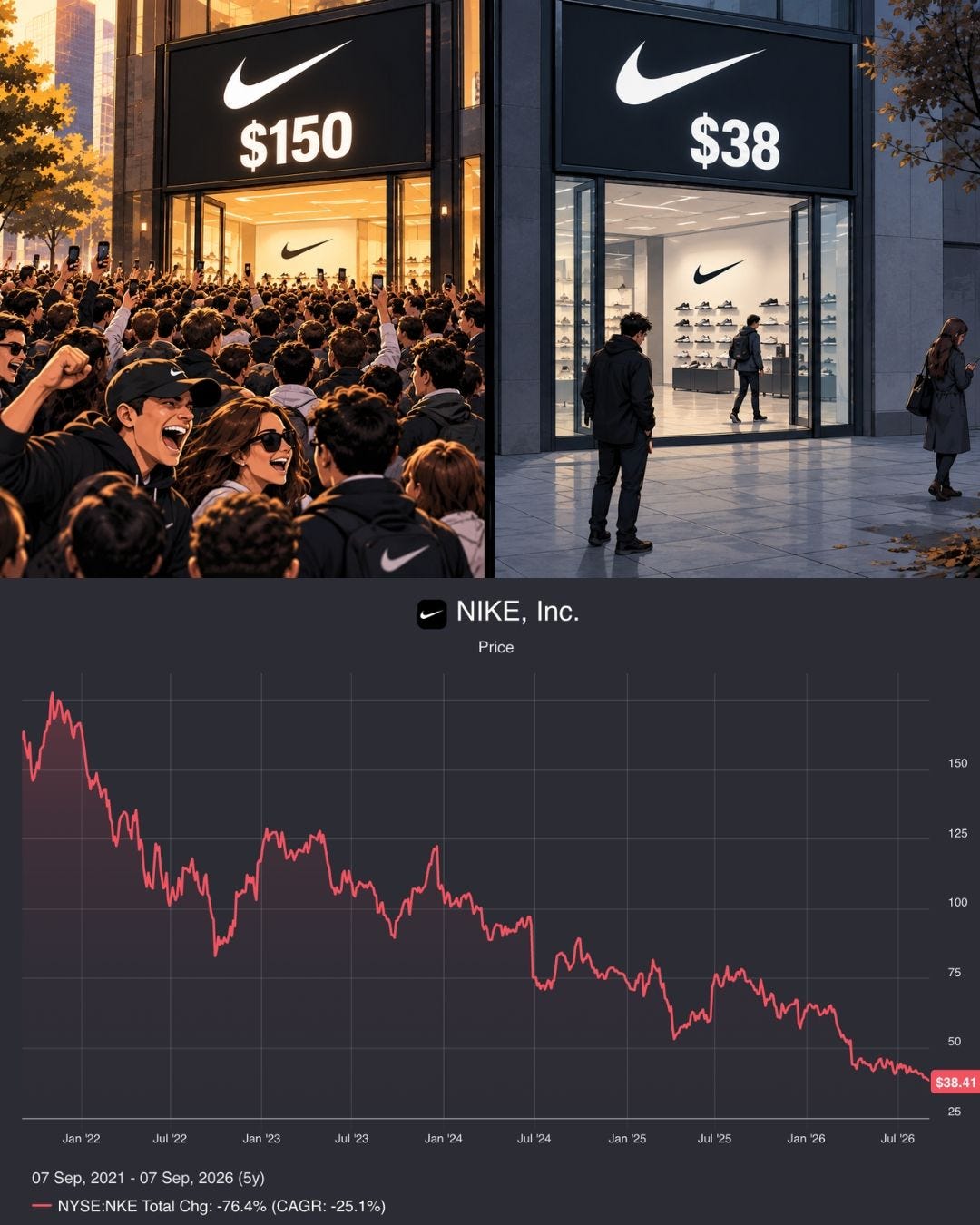
That’s usually when things start to get interesting.
A falling stock is not automatically a cheap stock.
And a great brand is not automatically a great investment.
But at this price, Nike is worth studying.
The question is no longer whether Nike is a famous company.
It is whether the market has become too pessimistic about what the business can earn from here.
Why it’s worth watching
Nike is one of the strongest consumer brands in the world.
But revenue, margins, China, and its direct-to-consumer business have all moved in the wrong direction.
That combination — high business quality, weak recent fundamentals, and a much lower valuation — creates an interesting setup.
Not necessarily an opportunity yet.
But something worth watching closely.
What it does
Nike designs and sells athletic footwear, apparel, and equipment.
Footwear accounts for roughly two-thirds of revenue.
The business reaches consumers through both wholesale partners and Nike’s own stores and digital channels. In FY2026, NIKE Brand wholesale revenue was about $27.5 billion, while Direct generated roughly $17.7 billion.
The economic engine is simple:
Nike invests in product innovation, athletes, storytelling, distribution, and brand.
Consumers pay a premium because of what the Swoosh represents.
That brand has been built over decades.
The harder question is whether Nike can convert that brand equity back into consistent growth and higher free cash flow per share.
Why it may be mispriced
Nike’s stock has collapsed because the problems are real.
FY2026 revenue was about $46.4 billion, down from $51.4 billion in FY2024.
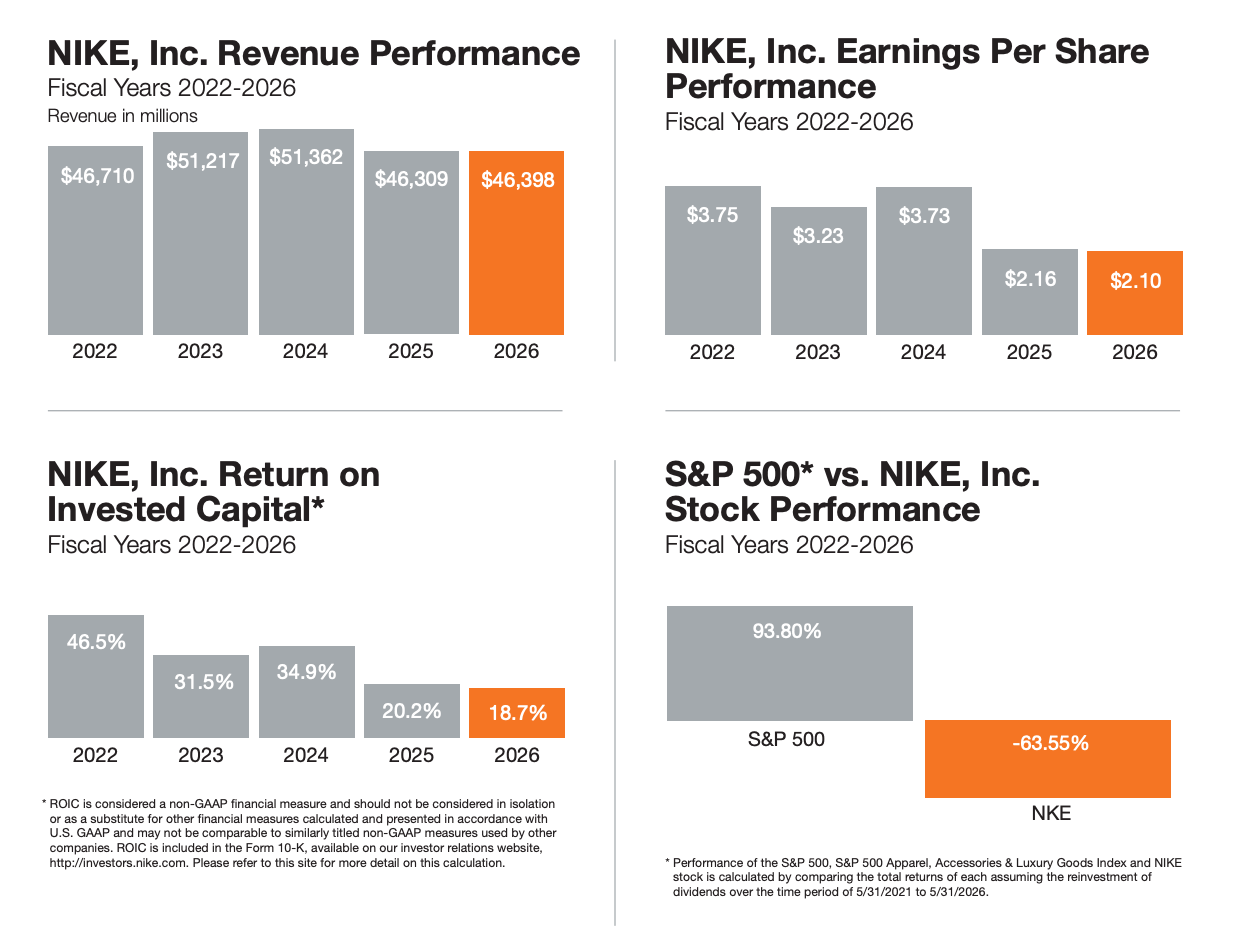
Revenue was roughly flat on a reported basis and down 2% currency-neutral. NIKE Direct fell 8% currency-neutral, while Greater China declined 13%.
Margins have also deteriorated.
Operating profitability is well below prior levels, while competitors such as On, Hoka, adidas, New Balance, and others have gained relevance in important categories.
The market is no longer pricing Nike like an untouchable compounder.
At roughly $38 against FY2026 diluted EPS of $2.10, the stock trades around 18x depressed earnings.
That is not obviously distressed.
But it is very different from the valuation investors were willing to pay when expectations were much higher.
The potential mispricing is therefore that the market may be pricing today’s operational problems too far into the future.
If Nike only needs to stabilize earnings and return to modest per-share growth, the current valuation becomes much more interesting.
What matters
Four things matter from here.
1. Revenue growth
The first signal is simple: can Nike return to positive currency-neutral growth?
A turnaround without organic growth is mostly financial engineering.
2. Direct and digital
NIKE Direct declined 8% currency-neutral in FY2026.
The company needs to prove that its owned channels can return to growth without relying heavily on promotions.
3. China
Greater China remains one of the clearest tests of the thesis.
Revenue there has fallen materially, and continued weakness would suggest the problem is more structural than cyclical.
4. Cash flow and returns on capital
FY2026 ROIC remained healthy at roughly 18.7%, but below prior levels, while estimated free cash flow was only around $2.2 billion.
The real confirmation would be a return toward $4–5 billion of free cash flow and ROIC above 20% without requiring aggressive discounting.
That would tell us the engine is actually recovering.
The risk
The biggest risk is not that Nike disappears.
It is that Nike remains a great brand but becomes a mediocre compounder.
Consumers have almost no switching costs.
Nike competes every day for attention against adidas, On, Hoka, New Balance, Anta, and others.
The failure case is therefore easy to imagine: the Swoosh remains globally recognized, but competitors keep taking share in the fastest-growing categories.
China never fully recovers.
Digital remains weak.
Nike regains volume through promotions rather than product desirability.
Margins stay structurally below historical levels.
In that world, today’s valuation may not be particularly cheap.
The brand survives.
The economics change.
That is the risk.
Where we stand
Status
Watchlist
Fair Value
$42–52 per share
Central Fair Value
~$47
Margin Of Safety
~15–20%
Buy Zone
≤ $32
Expected CAGR — Base Case
~14% over five years
Thesis
Nike does not need to return to its old growth rate for the current valuation to work.
The base case assumes roughly 7% EPS growth over five years, around $2.95 of FY2031 EPS, and a 22x terminal multiple. Including modeled dividends, that produces an estimated annualized return of roughly 14%. The key variable is whether Nike can restore normalized EPS and free cash flow per share while maintaining high returns on capital.
The bottom line
Nike is not interesting because it fell from $150 to $38.
Past prices tell us very little about intrinsic value.
Nike is interesting because the expectations embedded in the stock have changed dramatically while the underlying franchise still retains meaningful strengths.
Today, we have a powerful brand attached to a struggling operating engine.
That creates uncertainty, but it may also create mispricing.
For now, Nike belongs in The Universe because the gap between what the company has been and what the market now expects it to become is large enough to study.
Until next time,
Luca
What makes this interesting is the distinction you draw between a brand recovering and its economics recovering. Nike could regain sales through promotions while earning less on each sale, so revenue growth alone may give a false sense of progress. I’d watch whether full-price demand improves alongside free cash flow per share and returns on capital. Your point about competitors is crucial here: the Swoosh can remain valuable even if consumers increasingly choose another shoe. That makes this a patient watchlist case, with the quality of the recovery mattering more than the size of the share-price decline.