

Some ideas deserve attention before they deserve capital.
This series is where we study one asset at a time, define the risk, and decide what price would make the bet worth taking.
This is not financial advice.
This week’s Research Note is about:
Adyen — $ADYEN
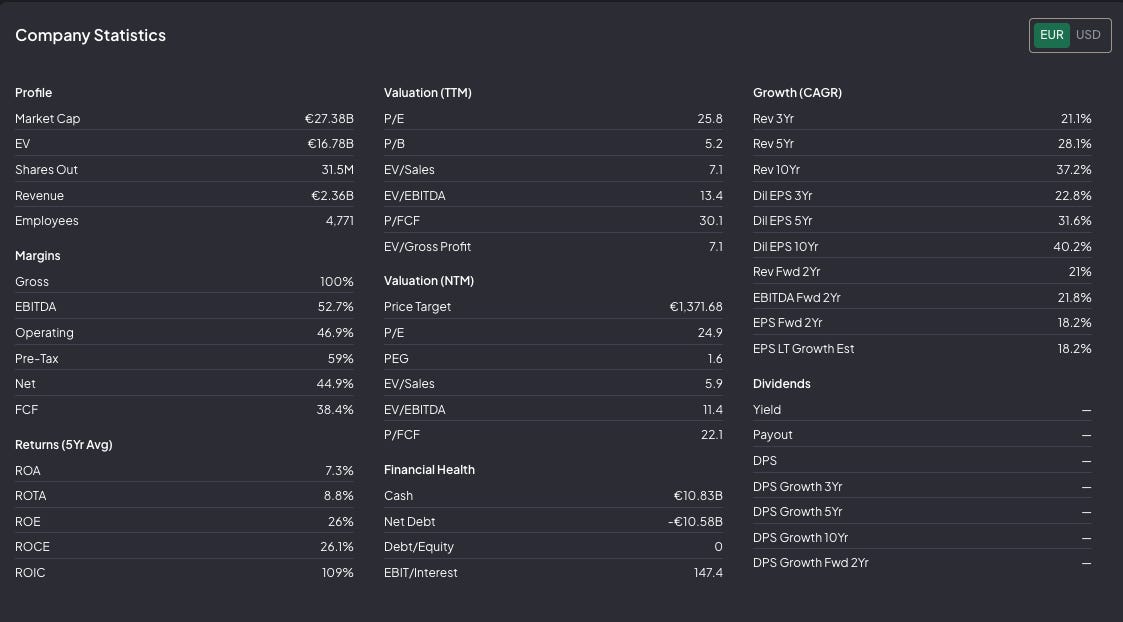
1. Why We Are Watching It
We are watching Adyen because:
It is one of the highest-quality payment businesses in Europe.
It has strong cash generation, high margins, and no material financial debt.
It still has a credible runway across enterprise payments, Unified Commerce, Platforms, and financial products.
The simple thesis:
Adyen is a high-quality payments compounder that can keep growing owner earnings per share at attractive rates if it protects its take rate, margins, and customer relevance.
The key question:
Can Adyen keep compounding owner earnings per share at mid-teens rates without giving up pricing power or destroying capital through acquisitions?
2. What It Does
Adyen is a global payments platform for large merchants and platforms.
It helps companies accept payments online, in stores, and across countries through one infrastructure layer.
It makes money through:
Processing and settlement fees
Acquiring services
Risk management
Issuing and financial products
Payment terminals and related services
The customer pays Adyen because payments are mission critical.
3. What We Like
The attractive parts:
Mission-critical infrastructure: Adyen sits inside the payment flow of large merchants. If the system fails, transactions fail. That creates real switching costs.
Strong economics: the business produces high EBITDA margins, strong free cash flow, and needs limited capital to grow.
Global single-platform model: Adyen’s value is simplicity. Large merchants can use one integration across countries, channels, and payment methods.
Long growth runway: Unified Commerce, Platforms, geographic expansion, and financial products can keep expanding the revenue base.
What we’re really looking for:
A durable asset with attractive economics, clear risks, and a price that gives us room to be wrong.
4. What Scares Us
The risks:
Growth disappointment: the stock still prices in strong compounding. If growth slows faster than expected, the valuation can compress.
Take rate pressure: payments is a competitive market. If Adyen has to give up economics to keep volume, owner earnings growth could disappoint.
Margin pressure: Adyen is investing in people, products, and expansion. That is fine if it creates future earnings. It is a problem if returns fade.
Capital allocation risk: the Talon.One acquisition is a meaningful deal. The strategic logic may be sound, but the return on capital is not yet proven.
5. Quality Score
Business Quality — 5/5
Durable business
Strong enterprise positioning
High switching costs
Mission-critical product
Global scale
Financial Quality — 5/5
High margins
Strong cash generation
Low capital intensity
No material financial debt
Attractive reinvestment potential
Management / Execution Quality — 3/5
Strong execution history
Founder-led culture
Long-term orientation
But Talon.One increases capital allocation risk
Total Score
13/15
6. Fair Value Range
Our rough fair value range:
