

Some ideas deserve attention before they deserve capital.
This series is where we study one asset at a time, define the risk, and decide what price would make the bet worth taking.
This is not financial advice.
This week’s Research Note is about:
Cirrus Logic — CRUS -1.65%↓
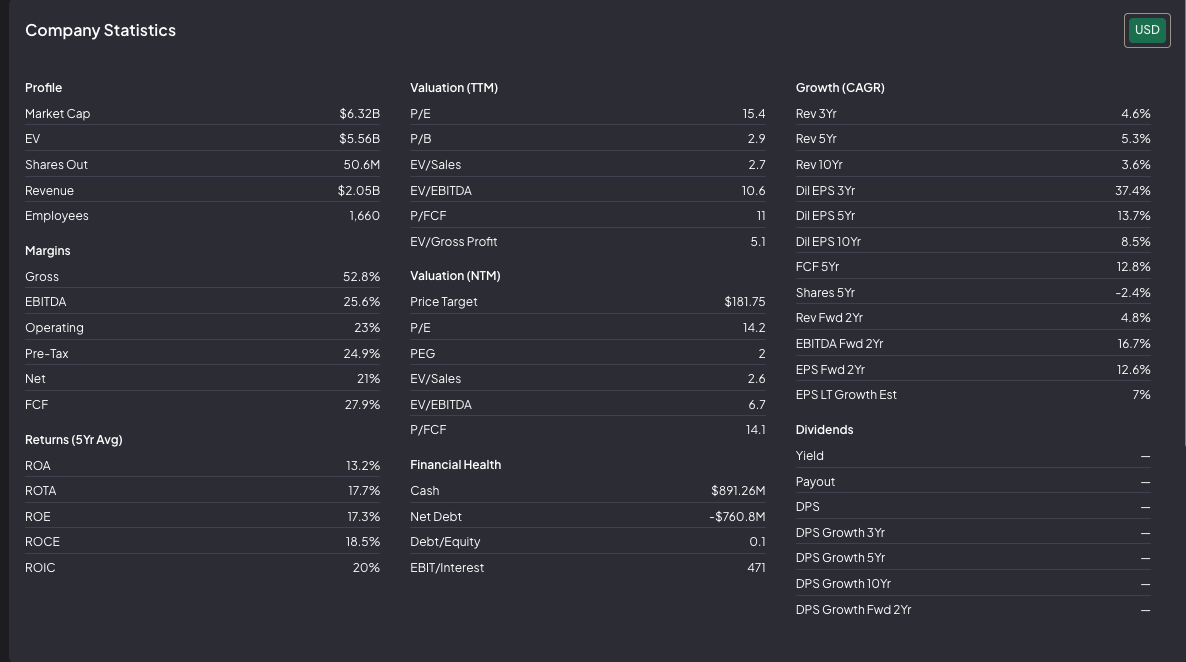
1. Why We Are Watching It
We are watching Cirrus Logic because:
The business generates strong margins and free cash flow.
Returns on capital are close to 20%.
A broader product pipeline could reduce its dependence on smartphones over time.
The simple thesis:
Cirrus Logic is a high-quality semiconductor business priced below our estimated value, but its dependence on one customer prevents us from treating it like a fully durable compounder.
The key question:
Can Cirrus build meaningful revenue streams outside its largest customer before that concentration becomes a problem?
2. What It Does
Cirrus Logic designs low-power mixed-signal chips used primarily in smartphones, laptops, and other electronic devices.
Its products help customers improve:
Audio performance
Power efficiency
Camera control
Haptics and user interaction
Hardware and software integration
It makes money by selling proprietary components to original equipment manufacturers and contract manufacturers.
Its main product areas include:
Smartphone audio chips
High-performance mixed-signal products
Camera controllers
Power-management chips
PC and laptop audio solutions
Cirrus is a fabless semiconductor company. It designs the chips but relies on outside manufacturers to produce them. Its value comes from engineering knowledge, intellectual property, integration, and its ability to help customers bring better products to market.
The company has thousands of patents and technical switching costs once its products are designed into a device. But it does not have network effects or contractually recurring revenue.
3. What We Like
The attractive parts:
Strong cash generation: Cirrus converts a large share of its earnings into cash. Its free cash flow margin has historically been unusually strong for a semiconductor business.
High returns on capital: five-year average ROIC has been around 19%–20%. That suggests the company has been able to generate attractive profits from the capital required to operate.
Clean balance sheet: Cirrus holds net cash rather than net debt. That reduces financial risk and gives management flexibility during weaker industry periods.
Asset-light economics: the fabless model requires limited capital expenditure. Recent analysis estimates capex at roughly 1% of sales, making normalized earnings a reasonable proxy for owner earnings.
A more credible reinvestment pipeline: potential growth areas now include camera controllers, smart power chips, AI PC audio products, analog front ends for smart metering, and longer-term opportunities in data-center power, grid infrastructure, and electric-vehicle charging.
Disciplined repurchases: management has regularly used free cash flow to reduce the share count. The board added a new $500 million repurchase authorization in 2025 after an earlier $500 million authorization.
The company’s operating margin is around 23%, with gross margins above 50%. Its economics look like those of a quality compounder. The unresolved question is whether those economics can survive meaningful customer diversification.
What we’re really looking for:
A durable business with attractive economics, clear risks, and a price that gives us room to be wrong.
4. What Scares Us
The risks:
Extreme customer concentration: Approximately 90% of revenue comes from one customer. A change in product strategy, sourcing, pricing, or internal chip development could materially affect Cirrus.
Limited bargaining power: a dominant customer can negotiate aggressively, add a second supplier, reduce Cirrus’s content per device, or move parts of the design in-house.
Diversification remains unproven: PC, automotive, industrial, and general-market products are promising, but they remain too small to offset a major loss in smartphone revenue.
Fabless supply-chain risk: Cirrus depends on third parties for manufacturing capacity. Supply constraints, production delays, or unfavorable wafer commitments could affect revenue and margins.
5. Quality Score
Business Quality — 3/5
Strong position in specialized mixed-signal chips
Valuable engineering knowledge and intellectual property
Moderate technical switching costs after a design win
No network effects
Durability weakened by customer concentration
Financial Quality — 4/5
Strong free cash flow
ROIC near 20%
Net-cash balance sheet
Attractive margin structure
Limited capital intensity
Management / Execution Quality — 2/5
Disciplined share repurchases
Conservative balance sheet
Good execution in core products
Broader product pipeline is developing
Diversification has not yet produced meaningful revenue independence
Total Score
9/15
6. Fair Value Range
Our rough fair value range:
