

This week’s Research Note is about:
Regal Rexnord Corporation — RRX -4.27%↓
1. Why We Are Watching It
We are watching Regal Rexnord because:
The business has been transformed into a higher-margin industrial platform.
It has exposure to attractive markets including automation, data centers, aerospace, defense, and industrial efficiency.
The stock has moved into a valuation range where the downside/upside equation is becoming more interesting.
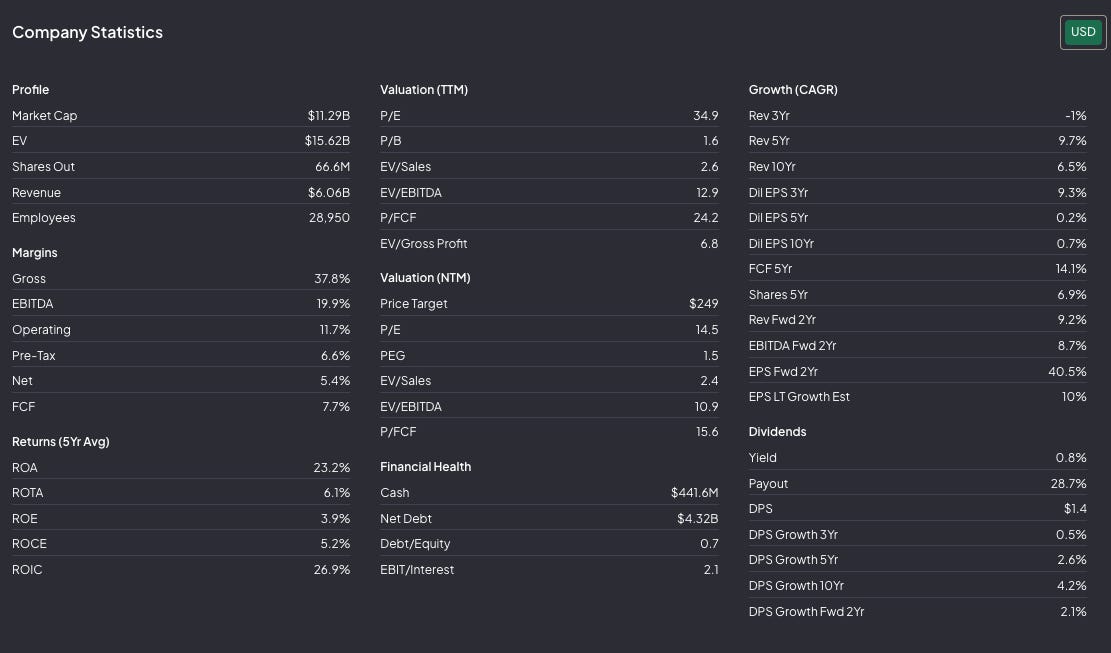
The original transformation is meaningful. From roughly 2018 to 2025, gross margin increased from about 27% to 38%, adjusted EBITDA margin moved from about 15% to 22%, and free cash flow grew from roughly $285 million to $520 million.
More recently, demand has improved. Q2 daily orders increased 8.8%, organic sales grew 3.3%, and the Automation & Motion Control segment grew organically by 15.6%, supported by data centers, discrete automation, and aerospace & defense
The simple thesis:
Regal Rexnord could become a high-quality industrial compounder if stronger end-market exposure, margin improvement, and integration benefits translate into durable free cash flow while the balance sheet continues to improve.
The key question:
Can Regal Rexnord turn its transformation into sustainable free cash flow growth without leverage, cyclicality, and execution risk consuming too much of the upside?
2. What It Does
Regal Rexnord is an industrial technology company focused on moving, controlling, and transmitting power.
Its products include motors, bearings, gearing, couplings, brakes, drives, actuators, air-moving systems, and other motion-control components.
It sells to OEMs, distributors, and industrial customers across markets including:
Automation
HVAC
Data centers
Aerospace and defense
Medical
Energy
Mining
General industrial
Customers are not simply buying components.
They are often paying for reliability, energy efficiency, uptime, customization, and lower operating risk.
That matters because many of these components sit inside mission-critical applications.
3. What We Like
The attractive parts:
A real, if imperfect, industrial moat: switching costs can be meaningful in integrated OEM applications, the products are often mission-critical, and Regal Rexnord benefits from technical know-how, customer relationships, scale, service, and supply-chain capabilities.
Improving business quality: the company has materially improved its margin profile through its transformation: 38% gross margin, 22% adjusted EBITDA margin, and around 9% adjusted free cash flow margin.
Exposure to better structural growth markets: roughly half of sales are exposed to secular markets, with automation, aerospace and defense, medical, and data centers among the important growth areas. Recent order growth gives us more evidence that these exposures are becoming meaningful.
A clearer path to cash generation: management currently guides to around $600 million of 2026 free cash flow, or roughly $9 per share. The more important question is whether normalized FCF per share can eventually reach the estimated $10.80–$13.00 range.
At $169.49 the margin of safety has improved materially.
What we’re really looking for:
A durable asset with attractive economics, clear risks, and a price that gives us room to be wrong.
4. What Scares Us
The risks:
Leverage: net debt to adjusted EBITDA, including synergies, is around 3.06x. It is moving in the right direction, but debt still limits financial flexibility. Until leverage is clearly below 3x, aggressive buybacks or additional large acquisitions would make the story less attractive.
Free cash flow quality: 2026 FCF guidance is around $600 million, but working capital has become a bigger drag. The business needs to prove that cash conversion improves rather than remaining an annual adjustment story.
Cyclicality: this is still an industrial company. Residential HVAC, pool-related demand, general industrial activity, and other short-cycle markets can weaken. A better portfolio does not remove the cycle.
Execution risk: the thesis still depends on productivity improvements, acquisition synergies, favorable mix, integration, and continued growth in higher-quality verticals.
5. Quality Score
Business Quality — 4/5
Good market position
Mission-critical products
Meaningful OEM relationships and switching costs
Better exposure to secular growth markets
But no network effects or strong recurring-revenue model
Financial Quality — 3/5
Improving margins
Good underlying cash-generation potential
Attractive reported ROIC, though acquisition accounting makes normalization important
FCF conversion still needs proof
Leverage remains meaningful
Management / Execution Quality — 3/5
Significant business transformation has been executed
Margin improvement has been real
Deleveraging is currently the right capital-allocation priority
Integration still needs to prove itself
Insider alignment is not particularly strong
Total Score
10/15
6. Fair Value Range
Our rough fair value range:
