

This week’s Research Note is about:
Paychex — PAYX 0.00%↑
0. Topics Covered
Why We Are Watching It
What It Does
What We Like
What Scares Us
Quality Score
Fair Value Range
Scenario Range
Buy Zone
Margin of Safety
Expected Value
QPOS Score + View
Final Takeaway
Let’s go.
1. Why We Are Watching It
We are watching Paychex because:
it operates a recurring, mission-critical business with high switching costs;
it has strong margins, strong cash generation, and an asset-light model;
the business quality looks better than the current investment setup.
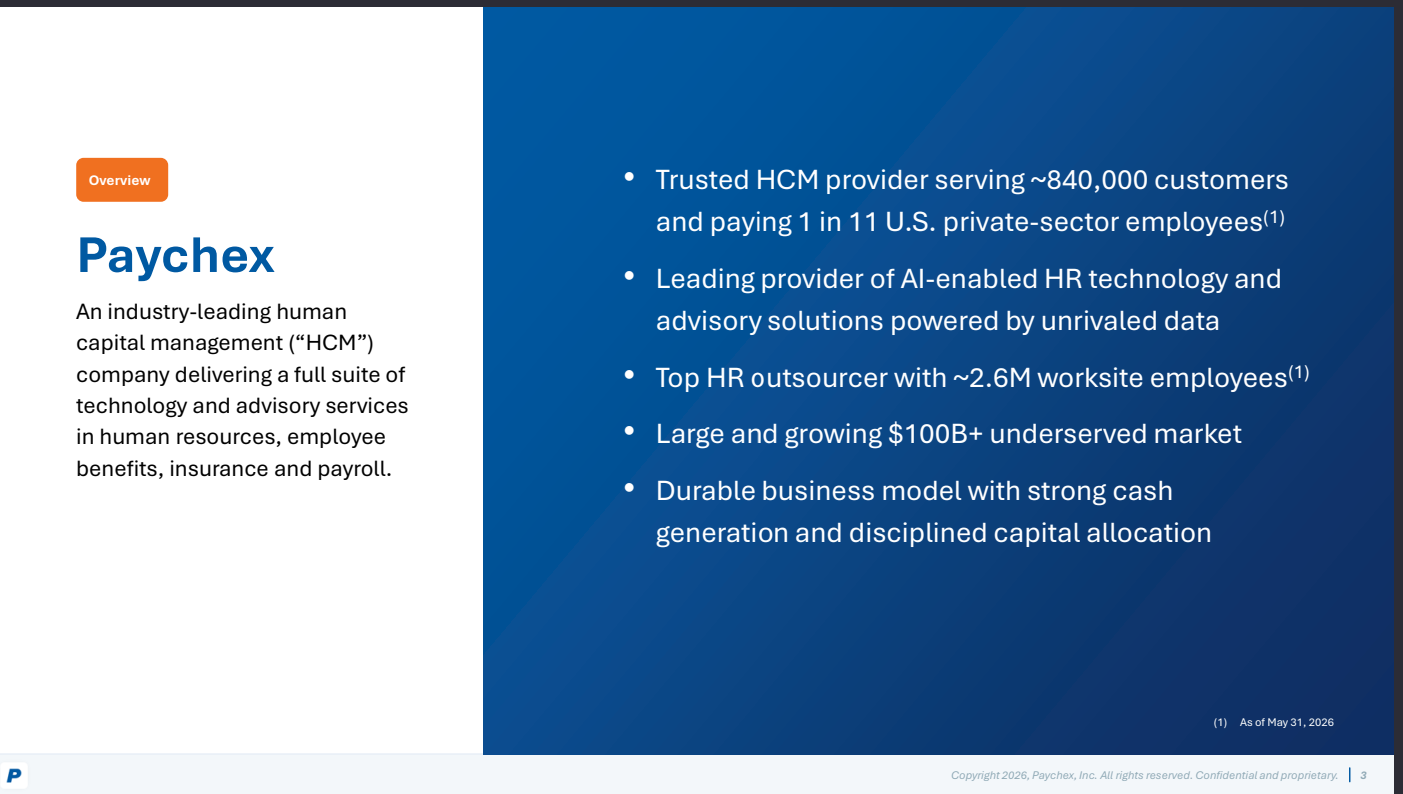
Paychex serves around 840,000 clients and says it pays roughly 1 in 11 U.S. private-sector workers. The model is built around payroll, HR, compliance, benefits, insurance, and PEO services.
2. What It Does
Paychex is a payroll and human-capital-management business serving mainly small and mid-sized companies.
It helps employers manage work they cannot afford to get wrong: payroll, taxes, HR, benefits, compliance, insurance, and employee administration.
It makes money through:
recurring payroll and HCM software/services;
HR outsourcing, PEO, and insurance;
interest earned on client funds held before payroll and tax payments.
The main growth drivers are client growth, pricing, revenue per client, cross-sell, PEO worksite employees, interest rates on client funds, and acquisitions.
3. What We Like
The attractive parts:
Durable moat: payroll and compliance are deeply embedded in customer workflows. Switching is possible, but it creates friction, execution risk, and administrative work.
Strong recurring economics: Paychex benefits from recurring revenue, pricing power, high retention, and mission-critical services. The business does not need heavy physical reinvestment to grow.
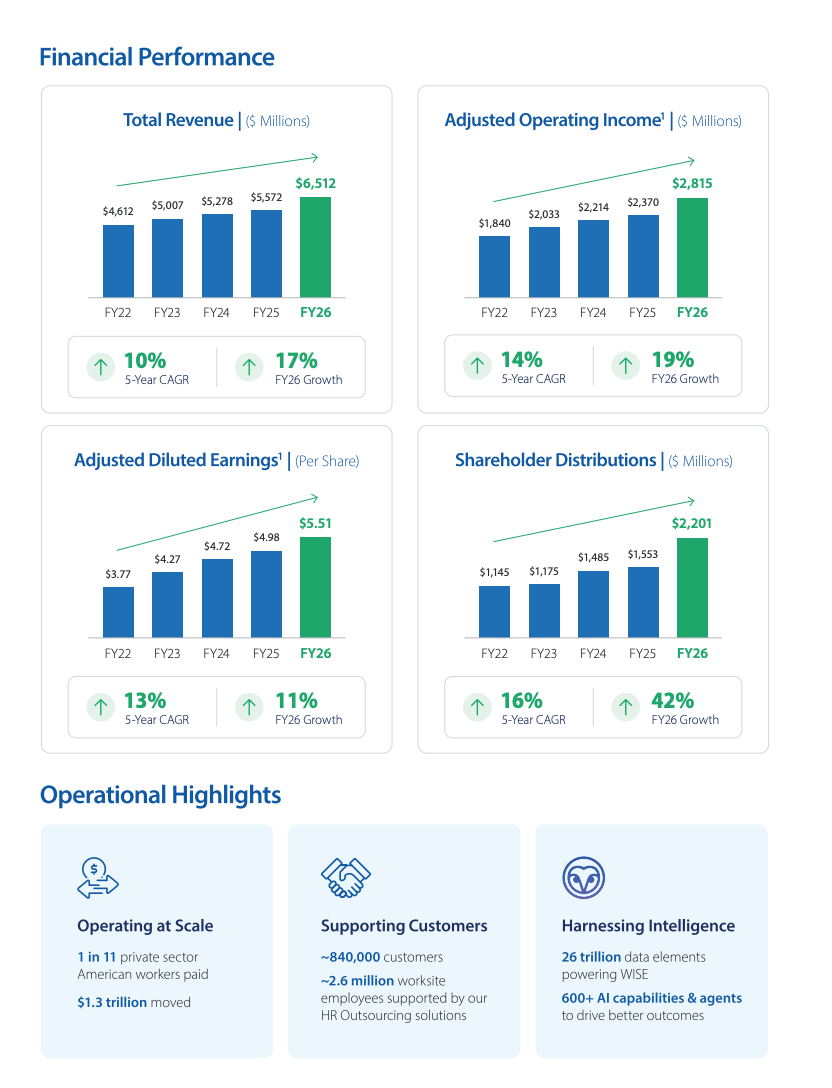
High cash generation: nine-month FY26 operating cash flow is about $2.0 billion while capex only about $169 million. That is the kind of capital-light structure we want to see.
Strong margins and operating leverage: Q1 FY27 revenue increased 6%, operating income increased 14%, and adjusted EPS increased 10% to $1.34. Adjusted operating margin improved to 42.0% from 40.7%.
Capital allocation: the company returns meaningful capital through dividends and buybacks. The issue is that the payout also limits the amount that can be reinvested organically, making pricing, cross-sell, and disciplined M&A more important to the long-term compounding story.
4. What Scares Us
The risks:
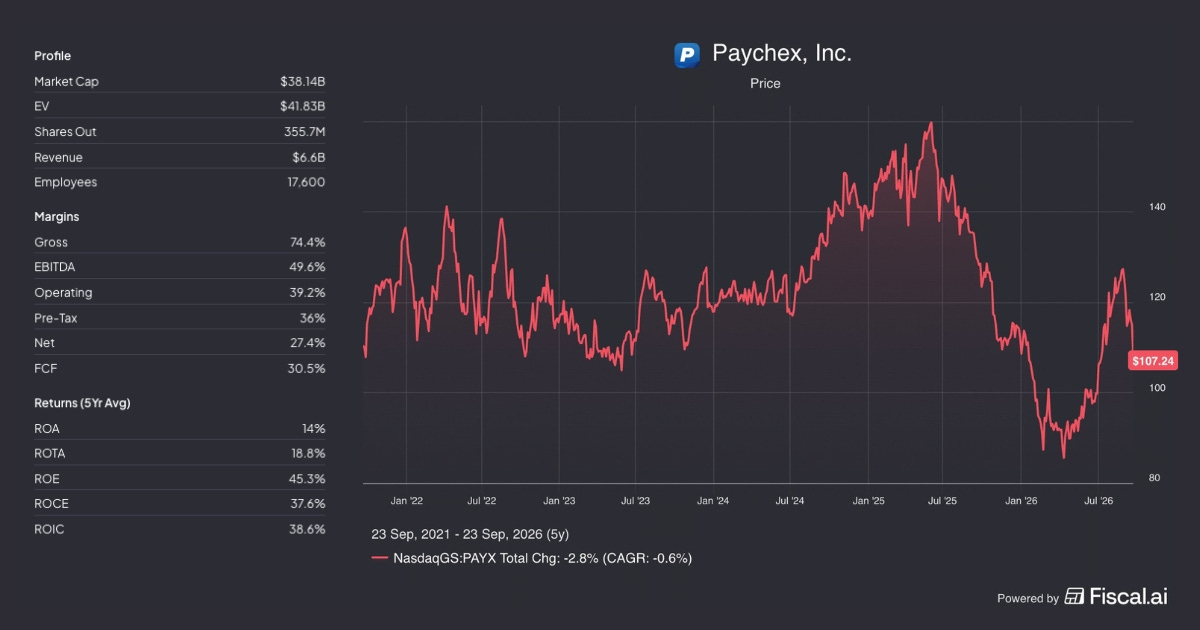
Paying too much: this is the main risk today. Paychex can remain an excellent company while producing mediocre shareholder returns if the starting multiple is too high.
Paycor integration: the ~$4.1 billion Paycor acquisition expands Paychex further upmarket, but it also introduces integration risk, additional debt, amortization, and the possibility that expected synergies disappoint.
Moderate organic growth: Paychex is not a hyper-growth business. Management's FY27 guidance points to total revenue growth of 5–6% and adjusted EPS growth of 7–9%.
Competition and AI: ADP, Paylocity, Intuit, Workday, and others compete across payroll and HCM. AI may help Paychex improve efficiency, but it may also lower barriers, improve competitor products, and increase pricing transparency.
5. Quality Score
Business Quality — 4.5/5
Durable recurring revenue
High switching costs
Strong market position
Mission-critical product
Pricing power
Financial Quality — 4.5/5
Strong cash conversion
Capital-light model
High margins
Strong operating leverage
Solid balance-sheet capacity, although Paycor increased leverage
Management Quality — 3.5/5
Consistent execution
Meaningful dividends and buybacks
Disciplined operating cost management
Paycor creates a new capital-allocation test
Organic reinvestment runway is good, but not exceptional
Total Score
12.5/15
6. Fair Value Range
Our rough fair value range:
