

This week’s Research Note is about:
Jack Henry & Associates — JKHY 0.00%↑
0. Topics Covered
Why We Are Watching It
What It Does
What We Like
What Scares Us
Quality Score
Fair Value Range
Scenario Range
Buy Zone
Margin of Safety
Expected Value
QPOS Score + View
Final Takeaway
Let’s go.
1. Why We Are Watching It
We are watching Jack Henry & Associates because:
it provides mission-critical software to banks and credit unions;
Its recurring revenue, high switching costs, and deep customer integration create a durable business;
the financial quality is strong: high returns on capital, good cash conversion, and very little balance-sheet risk.
2. What It Does
Jack Henry & Associates provides the software infrastructure that thousands of banks and credit unions use to run their operations.
Its systems support areas such as core banking, digital banking, payment processing, card services, fraud and risk tools, imaging and complementary software, hosting and cloud infrastructure.
The company serves roughly 1,670 core banking and credit-union clients, plus thousands of additional customers using non-core products.
It makes money through:
software support and subscriptions;
processing and transaction revenue;
hosting and private-cloud services;
payments;
complementary software and services.
A large part of the value comes from the fact that these systems sit deep inside a financial institution’s daily operations.
3. What We Like
The attractive parts:
High switching costs: core banking software is deeply integrated into customer workflows. Moving to another provider is a major operational project, which makes customer relationships sticky.
Recurring and mission-critical revenue: Jack Henry does not sell software customers can casually stop using. Its products help banks operate every day, and annual support, processing, hosting, and recurring contracts make revenue relatively predictable.
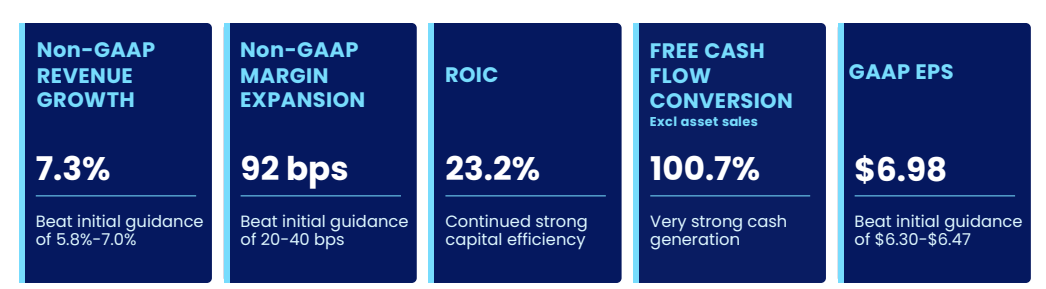
Strong returns on capital: FY26 NOPAT ROIC reached 23.2%, up from 21.5%. That is one of the strongest parts of the investment case. It suggests the company can produce substantial operating profit relative to the capital required to run the business.
Good cash generation: FY26 reported free cash flow was $539 million, but that included about $32.8 million of asset-sale proceeds. Adjusting for that gives roughly $506.5 million, almost exactly matching net income. Cash conversion remains strong.
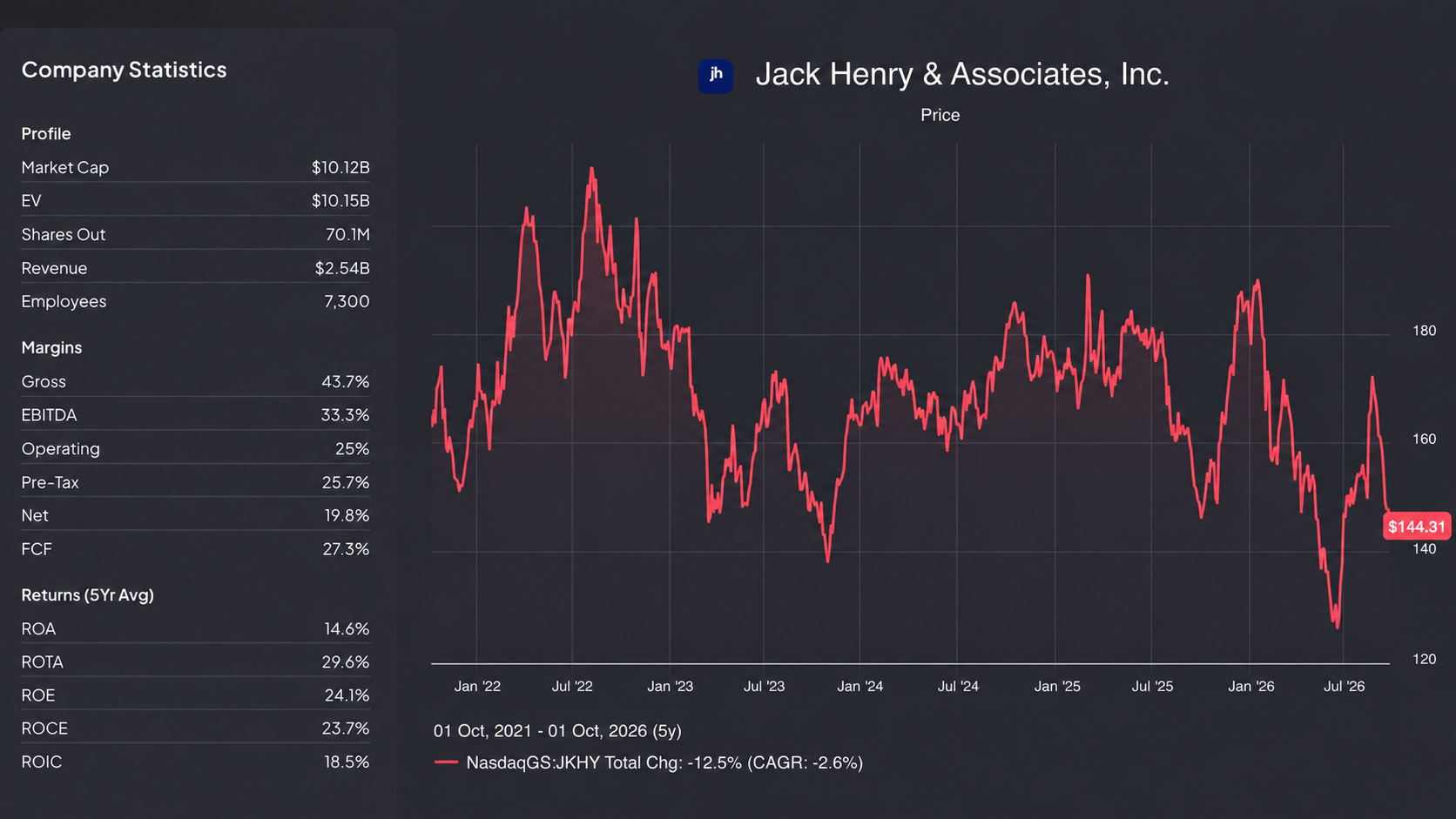
Disciplined buybacks are becoming more interesting: Jack Henry repurchased $448 million of stock in FY26 at an average price of $152, including $164 million in Q4 at roughly $140 per share.
4. What Scares Us
The risks:
Growth is good, not exceptional: Jack Henry operates in a relatively mature market. Future growth depends more on cross-selling, cloud modernization, payments, and gaining wallet share than on a massive greenfield opportunity.
Paying a quality multiple for average growth: this is probably the biggest risk. A company growing around mid-single digits can still disappoint shareholders if investors begin the journey paying too high a multiple.
Margin pressure: Q4 FY26 deserves attention. GAAP operating income fell 12.2%, while adjusted operating income declined 3.1%. R&D increased 17% and SG&A increased 19.2%. One quarter does not break the thesis, but FY27 needs to show that this was temporary rather than the start of structurally higher costs.
Cloud execution: the move toward more modern, cloud-native infrastructure is strategically necessary. But if the transition requires materially higher spending or creates stronger competitive pressure, margins and returns on capital could weaken.
5. Quality Score
Business Quality — 4/5
Strong switching costs
Mission-critical products
High recurring revenue
Durable customer relationships
Good competitive position
Financial Quality — 4/5
Strong free cash flow
FY26 NOPAT ROIC of 23.2%
Good cash conversion
Low financial leverage
Healthy operating margins
Management Quality — 3/5
Conservative balance-sheet management
Long acquisition history
Increasingly sensible buybacks
Reasonable communication around capital allocation
Total Score
11/15
6. Fair Value Range
Our fair value range:
