

Meta is still one of the strongest advertising businesses in the world.
But something important has changed.
Our original research described Meta as a quality compounder: exceptional network effects, strong pricing power, high returns on invested capital, and a business capable of producing substantial free cash flow.
That thesis has weakened.
Not because people have stopped using Instagram or Facebook. Not because advertisers are leaving. And not because Meta has lost its competitive advantage.
The problem is capital allocation.
Meta is becoming an increasingly capital-intensive business, committing enormous resources to AI infrastructure without yet demonstrating that the incremental returns justify the investment.
In the third quarter of 2026, operating cash flow was $32.8 billion. Capital expenditures, including finance lease principal payments, reached $34.9 billion.
Free cash flow turned negative.
At the same time, Meta announced plans for a new class of non-voting shares that could be used to raise capital without changing the company’s existing voting-control structure.
A recent post on X by @leevalueroach captured this concern particularly well.


The criticism is that a company once valued for its asset-light economics is increasingly behaving like a capital-intensive infrastructure business, while shareholders have limited influence over the decisions.
I agree with the underlying concern, although the distinction matters: the new share class enables potential future capital raising; the announcement itself is not evidence that such a raise has already occurred.
And one negative free cash flow quarter does not mean Meta has permanently lost its ability to generate cash.
But the direction deserves attention.
The business is still growing. The question is whether that growth is translating into more value per share.
Our framework has to reflect that distinction.
The original thesis is not broken. It is less attractive, less predictable, and more dependent on management getting several capital-intensive decisions right.
That requires a larger margin of safety, not a smaller one.
Let’s dive in:
Meta Platforms — META 0.00%↑
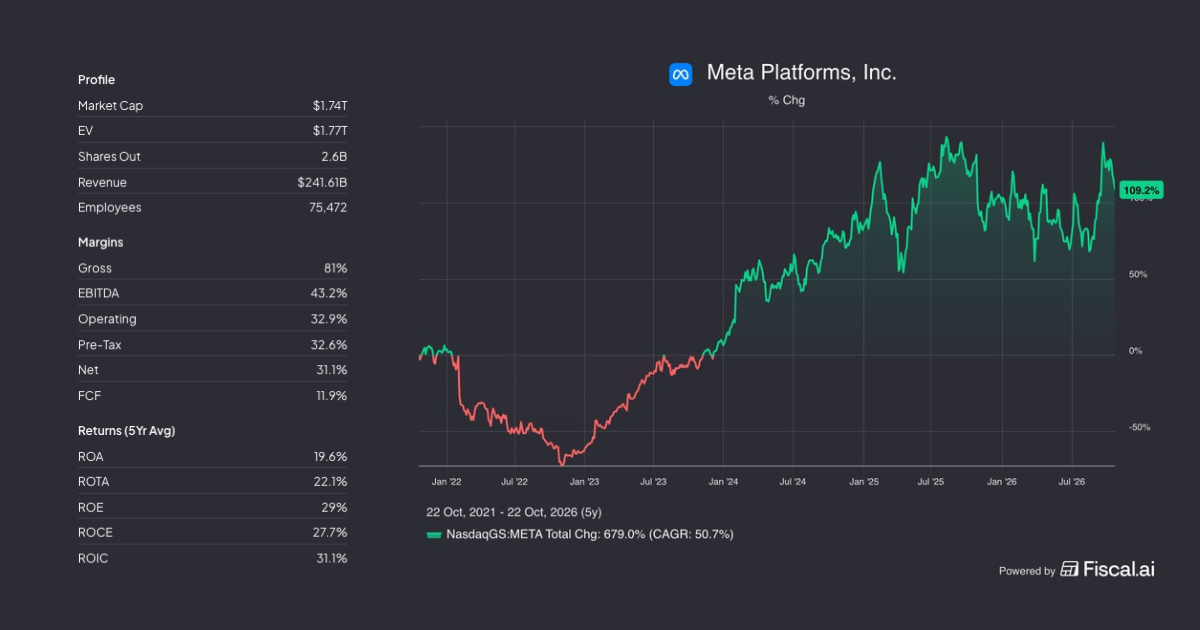
0. Topics Covered
Why We Are Watching It
What It Does
What We Like
What Scares Us
Quality Score
Fair Value Range
Scenario Range
Buy Zone
Margin of Safety
Expected Value
QPOS Score + View
Final Takeaway
Let’s go.
1. Why We Are Watching It
We are watching Meta for three reasons:
The core franchise remains exceptional → revenue grew 26% year over year in Q3 2026, supported by advertising volume, pricing power, and a global user base of approximately 3.64 billion daily active people.
The economics are changing → AI infrastructure spending is absorbing an increasing share of operating cash flow, reducing the company’s ability to translate revenue growth into free cash flow.
The valuation may not reflect the full capital allocation risk → the stock trades above our fair value range, while the potential returns in our five-year scenarios look unattractive.
Meta has an exceptional advertising moat, but increasingly aggressive AI investment, weaker cash conversion, and shareholder dilution risk have reduced the attractiveness of the investment at the current valuation.
Can Meta turn its unprecedented AI investment into sustainable growth in free cash flow per share, or is the company permanently sacrificing capital efficiency to defend its competitive position?
2. What It Does
Meta operates some of the world’s largest digital platforms, including Facebook, Instagram, WhatsApp, and Messenger.
Its business model is simple.
It captures attention and helps advertisers reach potential customers.
It makes money primarily through:
Digital advertising → businesses pay to show advertisements across Meta’s platforms.
Advertising optimization → AI-powered recommendations and targeting help advertisers improve performance, supporting advertising demand and pricing.
Emerging monetization → WhatsApp business services, messaging, and new AI products offer potential additional revenue streams.
Meta also operates Reality Labs, its virtual and augmented reality division.
That division remains significantly loss-making and contributes little to consolidated revenue.
The core investment case depends overwhelmingly on the Family of Apps business.
The complication is that the infrastructure required to support it is becoming much more expensive.
Meta is moving away from the economics of a predominantly asset-light platform toward a business that increasingly resembles a hybrid of an advertising platform and an AI infrastructure operator.
That transition is not automatically negative, but it changes the economics investors should be willing to underwrite.
3. What We Like
The attractive parts:
An exceptional competitive position: Meta’s advertising ecosystem remains extremely difficult to replicate. Its network effects, global reach, user engagement, and accumulated advertiser relationships create meaningful competitive advantages. The business continues to demonstrate pricing power. In Q3 2026, advertising impressions increased 10% year over year, while the average price per advertisement increased 14%. These are not the operating metrics of a broken franchise.
Strong underlying profitability: despite the deterioration in reported operating margins, Meta’s core business remains highly profitable.
The Q3 GAAP operating margin declined to 20% from 40% a year earlier.
However, the quarter included a $9.89 billion litigation charge.
Excluding that charge, operating margin would have been approximately 35.4%. That is still a strong margin. The legal charge also reminds us that exceptional operating economics do not eliminate regulatory and legal risk.
Historically attractive returns on capital: Meta’s five-year ROIC is at approximately 28.4%, alongside strong historical free cash flow margins.
Those figures reflect the quality of the original business model.
They do not necessarily describe the returns on the enormous amount of capital now being deployed into AI. This distinction is central to the updated thesis. Historical ROIC tells us what Meta was capable of earning. Incremental ROIC will tell us whether the next phase of investment is creating value.
AI and WhatsApp still offer meaningful optionality: AI is not purely a speculative expense. Better recommendation systems, advertising targeting, and automated campaign tools already support Meta’s core advertising franchise. WhatsApp also remains an important long-term monetization opportunity.
The bull case is credible: Meta could improve advertising efficiency, expand messaging revenue, and build valuable AI products on top of its existing distribution. The issue is not whether these opportunities exist, but whether they can generate enough incremental cash flow to justify the cost.
4. What Scares Us
The risks:
Capital intensity is increasing faster than cash generation: Q3 2026 operating cash flow reached approximately $32.8 billion. Capital expenditures, including finance leases, reached approximately $34.9 billion.
Free cash flow was negative $2.12 billion. Management expects full-year 2026 capital expenditures of $135–145 billion.
That fundamentally changes the investment equation. The key uncertainty is how much of this spending represents productive growth investment and how much will become necessary simply to remain competitive. If maintaining AI leadership requires continuous infrastructure replacement, structurally higher capital expenditures could persist.
Shareholder economics are becoming less attractive: our latest memo highlights approximately $21.05 billion of stock-based compensation during the first nine months of 2026. Over that period, share repurchases were effectively absent, and shares outstanding increased. Stock-based compensation is not economically free.
When it is not offset by buybacks, existing shareholders absorb dilution.
Revenue growth and EPS growth can look attractive while the economic value attributable to each share improves much more slowly.
Governance and capital allocation risk: in October 2026, Meta announced the creation of a new publicly listed, non-voting Class C stock, expected to become effective in January 2027. The structure is intended to provide flexibility for potential capital raising, employee compensation, acquisitions, and other corporate purposes. It also preserves the founder-led voting-control model. The initial stock dividend itself is not a conventional external equity raise and does not change shareholder voting power. Future issuance of additional Class C shares, however, could introduce further economic dilution without proportionate voting influence for the recipients.
This increases an already important governance concern.
Mark Zuckerberg’s long-term vision has created enormous value historically.
But founder control becomes more consequential when management can commit large amounts of capital to projects whose future economics remain uncertain.
Legal exposure, infrastructure costs, and execution risk: the Q3 litigation charge was extraordinary in accounting terms. But legal exposure may not be extraordinary in economic terms. Meta continues to face regulatory, privacy, competition, and youth-safety risks. At the same time, AI investment creates new risks involving depreciation, energy requirements, hardware replacement, technological obsolescence, and uncertain returns.
5. Quality Score
Business Quality — 5/5
Exceptional network effects.
Global distribution and large user base.
Strong advertising pricing power.
Durable relationships with advertisers.
Multiple avenues for monetization.
Financial Quality — 4/5
Historically high returns on invested capital.
Strong operating profitability in the core business.
Significant liquidity and operating cash generation.
Rapidly increasing infrastructure investment.
Deteriorating free cash flow conversion and greater financing obligations.
Management Quality — 2/5
Strong historical execution in advertising.
Successful development and acquisition of major platforms.
Questionable spending discipline in Reality Labs.
Increasing exposure to AI investment projects with uncertain payoffs.
Concentrated voting control and potential dilution.
Total Score
11/15
6. Fair Value Range
Our fair value range:
