

Stocks rallied. But not everyone joined the party.
Following the U.S. midterm elections, the broader market moved higher. Several companies tied to the AI infrastructure boom went in the opposite direction.
The reason?
Investors are increasingly concerned that tougher regulations and restrictions on new data centers could slow the AI buildout.
And those concerns are not completely irrational.
AI infrastructure requires enormous amounts of electricity, capital, and physical space. Political opposition to new data centers could make that expansion more expensive and complicated.
But there is another side to the story.
While share prices have fallen, earnings expectations across the semiconductor industry have continued to rise.
According to Citadel Securities, semiconductor stocks now trade at 13.8x forward earnings, compared with 18.3x for the S&P 500.
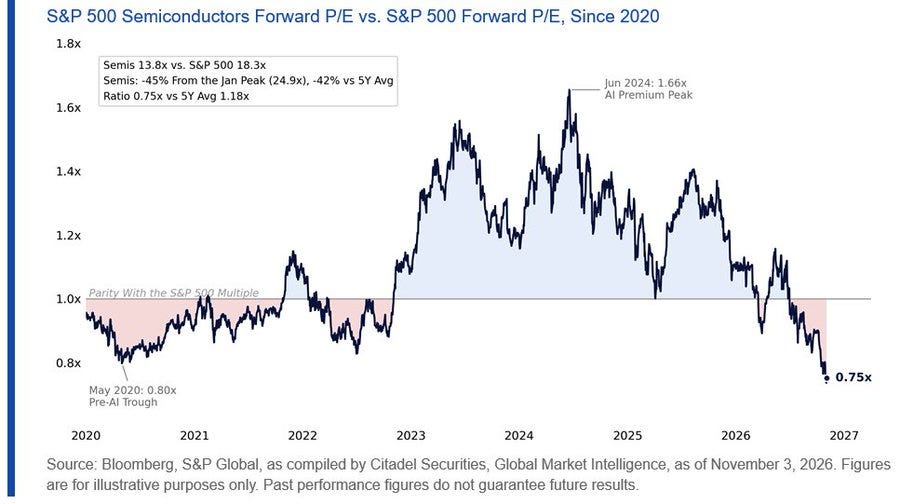
That is a 25% discount to the broader market.
The widest since December 2018.
Meanwhile, semiconductor forward earnings estimates have increased roughly 30% since June.
Prices are falling faster than earnings expectations.
This does not mean every semiconductor stock is a bargain.
Some businesses will struggle if AI infrastructure spending slows. Others may face competition, margin pressure, or weaker returns on capital.
The opportunity is not to buy everything that has fallen.
It is to identify the businesses where the long-term economics remain strong, even if market expectations are changing.
NVIDIA is back below $200. Its next-12-month P/E is around 16.5x, near its lowest level in more than a decade.


For a company that has become central to the AI infrastructure boom, that deserves a closer look.
A lower multiple does not automatically make an investment attractive.
But it changes the question.
Let’s dive in:
NVIDIA — NVDA 0.00%↑
0. Topics Covered
Why We Are Watching It
What It Does
What We Like
What Scares Us
Quality Score
Fair Value Range
Scenario Range
Buy Zone
Margin of Safety
Expected Value
QPOS Score + View
Final Takeaway
Let’s go.
1. Why We Are Watching It
Three reasons stand out:
The business is still exceptionally strong → NVIDIA has become one of the most important suppliers of AI computing infrastructure. Its competitive advantage extends beyond chips into networking, systems, software, and its developer ecosystem.
The economics are unusually attractive → the company produces operating margins, cash flow, and returns on capital that few businesses can match.
The valuation has changed → at 16.5x forward earnings, investors are paying a much lower multiple for a business whose latest reported growth remains extraordinary.
So, Can NVIDIA protect its competitive advantage and profitability as AI infrastructure spending becomes more regulated, competitive, and capital-intensive?
That question matters more than the next move in the stock price.
2. What It Does
NVIDIA is not just a GPU company anymore.
It is an accelerated computing platform.
In simple terms, NVIDIA provides much of the technology required to build and operate modern AI infrastructure.
Its customers use NVIDIA products to train AI models, run inference, and process increasingly complex workloads.
It makes money primarily through:
AI computing: GPUs and computing systems used for training and inference.
Networking and infrastructure: Technologies connecting processors, servers, and AI data centers.
Software and platforms: Tools such as CUDA that help developers build and optimize applications on NVIDIA hardware.
Other businesses: Gaming, professional visualization, automotive, and robotics.
The Data Center segment represented more than 92% of quarterly revenue in Q2 FY2027.
This concentration tells us something important: NVIDIA’s future is increasingly tied to the economics of AI infrastructure.
If AI computing demand keeps expanding, NVIDIA is positioned to benefit. If the investment cycle slows materially, the company will feel it.
3. What We Like
The attractive parts:
A competitive advantage beyond hardware → NVIDIA’s moat is not simply that it makes powerful chips. It combines hardware, networking, complete systems, software, and a large developer ecosystem. CUDA makes it easier for developers to build applications around NVIDIA infrastructure. Once customers have invested in that ecosystem, moving to an alternative can involve meaningful cost, time, and technical risk. That creates switching costs. The risk is that large customers have powerful incentives to develop alternatives. NVIDIA must keep earning its advantage through execution.
Exceptional profitability → The latest financial results show how profitable the business has become. NVIDIA generated approximately $63.7 billion of GAAP operating income on $96.2 billion of quarterly revenue and its gross margin reached 75%.
Strong cash generation → During the first half of FY2027, NVIDIA generated approximately $74.4 billion in operating cash flow. Cash purchases of property, equipment, and intangibles were around $4.4 billion. The business remains highly profitable without requiring an equivalent amount of traditional physical capital investment on its own balance sheet. However, this picture is becoming more complicated as NVIDIA commits more capital to supply, cloud capacity, and the broader AI ecosystem. That deserves close monitoring.
A long reinvestment runway → NVIDIA has several potential growth drivers beyond the current training boom: AI inference, networking, the transition from Blackwell to Vera Rubin, enterprise AI, robotics and physical AI, software and AI infrastructure services. The important point is that NVIDIA has several ways to increase the value of its existing platform. The business also has a history of executing major technology transitions. That strengthens the thesis, although it does not eliminate execution risk.
4. What Scares Us
The risks:
AI capital spending may slow → the largest technology companies are investing extraordinary amounts into AI infrastructure, but their budgets are not unlimited. At some point, customers need to generate sufficient economic value from AI to justify continued spending. If returns disappoint, new projects could be delayed or canceled. New data center restrictions would add another obstacle.
Customer concentration → NVIDIA is highly exposed to a relatively small group of large buyers. Three direct customers accounted for approximately 16%, 15%, and 13% of first-half revenue, respectively. Those customers have significant purchasing power. They also have incentives to design their own chips.
Competition and pricing pressure → Custom accelerators, alternative GPU architectures, and internally developed chips could reduce dependence on NVIDIA. A growing AI market does not guarantee that NVIDIA will maintain its current market share or margins. The company needs to keep improving its platform faster than competitors can close the gap.
Capital allocation is becoming more complicated → NVIDIA is no longer operating purely as a relatively asset-light chip supplier. Our latest research memo identified approximately $366 billion of future commitments, including $279 billion related to supply and capacity. It also highlighted expanding equity investments and potential financial support for the wider AI ecosystem. These commitments are not all equivalent to debt or immediate cash spending, but they increase NVIDIA’s exposure to the financial health of the companies building and buying AI infrastructure. If NVIDIA increasingly needs to help finance demand for its own products, the quality of that demand becomes harder to judge.
5. Quality Score
Business Quality — 5/5
Dominant position in AI infrastructure.
Powerful ecosystem built around CUDA.
High switching costs for customers.
Strong pricing power and competitive moat.
Long-term growth opportunities in AI computing and inference.
Financial Quality — 5/5
Exceptional operating margins.
ROIC around 100%.
Strong free cash flow generation.
Highly profitable, relatively asset-light business model.
Increasing capital commitments and working capital requirements.
Management Quality — 3/5
Proven execution across multiple GPU generations.
Strong innovation and product development.
Consistent investment in research and development.
Increasing complexity in capital allocation.
Growing financial exposure to the AI ecosystem.
Total Score
13/15
6. Fair Value Range
Our fair value range:
