

Most investors do not fail because they lack opinions.
They fail because they lack a decision system.
Markets are noisy. Prices move. Narratives change. Fear and greed take turns pretending to be insight. In that environment, the investor’s first job is not to predict every outcome. It is to protect the quality of the process.
Benjamin Graham’s core lesson was not simply “buy cheap stocks.” It was deeper than that. Successful investing requires a sound theoretical framework for making decisions, and the emotional discipline to keep that framework from being corroded by market behavior.
The more irrational the market becomes, the more opportunity it may offer to the prepared investor.
That is the philosophy behind The Mispriced.
Research indexes built to act as a decision machine.
Why a decision machine matters
Every investment decision is a bet made with incomplete information.
We do not know the future. We do not control the outcome. We can make a good decision and get a bad result. We can make a poor decision and get lucky.
Annie Duke calls this the problem of separating decision quality from outcome quality. In uncertain environments, the result is only partial feedback.
That is exactly why process matters.
A research index forces the question before emotion takes over:
What did we believe?
Why did we believe it?
What price were we paying?
What could go wrong?
How much risk did the idea deserve?
What would make us change our mind?
The goal is not to remove human judgment. That is impossible. The goal is to make judgment more consistent, more accountable, and less vulnerable to mood.
QPOS: the operating system
At the core of our index methodology is QPOS:
Quality.
Price.
Odds.
Sizing.
Every opportunity is evaluated through four questions.
Quality: Is this asset, business, or investment structure worth owning?
We are looking for durability, balance sheet strength, reinvestment ability, cash generation, capital discipline, and downside resilience. Quality does not mean comfort. It means the asset has something real behind it.
Price: Are we being paid enough for the risk?
Price is where expectations live. A great asset can be a poor investment at the wrong price. A hated asset can become attractive when the market’s expectations fall too far. Graham’s margin of safety still matters because the only risk no investor can eliminate is the risk of being wrong.
Odds: Is the expected value asymmetric?
We are not looking for certainty. We are looking for setups where the range of possible outcomes appears skewed in our favor. Bear case. Base case. Bull case. Probability. Payoff. Invalidation.
Sizing: How much capital does this idea deserve?
Conviction without sizing discipline is dangerous. Liquidity, volatility, correlation, thesis strength, downside risk, and time horizon all matter. The question is not only “Is this interesting?” The question is “How much risk has this earned?”
QPOS does not replace human judgment.
It strengthens it.
Passive is not always passive
Traditional market-cap weighted indexes are often described as neutral.
That is only partly true.
They are rules-based. And rules create behavior.
When a stock rises enough, it becomes a larger part of the index. Sometimes it enters the index after a large move. When a stock falls, it becomes a smaller part of the index. Sometimes it exits after a large decline.
The result is simple: market-cap weighted indexes can end up buying recent winners after they have gone up and selling recent losers after they have gone down. Research Affiliates has argued that “passive” indexes are not as neutral as they appear and can embed hidden costs inside their selection and weighting rules.
This does not mean passive investing is bad.
It means indexes are not magic.
They are rules.
And rules matter.
We do not want to own something simply because it has become large. We want to own it because it has earned a place through quality, price, odds, and sizing.
Systematic does not mean blind
The word “quantitative” often sounds cold, opaque, or over-engineered.
We do not see it that way.
A systematic process is simply a way to reduce avoidable mistakes. Alpha Architect describes quantitative value investing as a tool that helps value investors acknowledge their own fallibility, protect against behavioral errors, and exploit the behavioral errors of others.
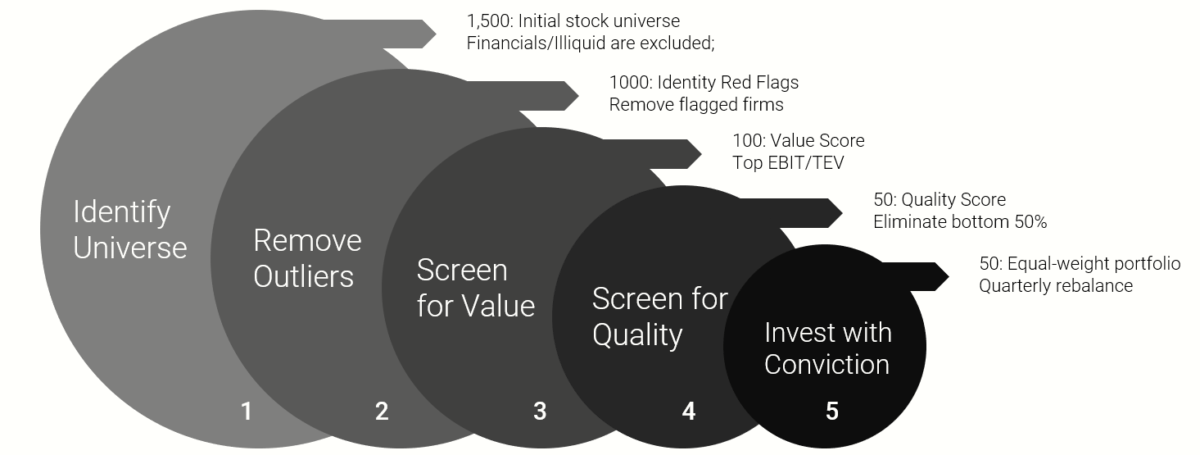
Their stated objective is direct: buy the cheapest, highest quality stocks in the market.
That is close to how we think.
We are not trying to outsource judgment to a machine.
We are trying to build a repeatable process that makes our judgment harder to fool.
The greatest threat to long-term investment performance is often not the market.
It is the investor.
Buying near the top because everyone feels safe. Selling near the bottom because everyone feels scared. Overreacting to recent results. Confusing volatility with risk. Confusing comfort with safety. Confusing a good outcome with a good decision.
A decision machine exists to slow those instincts down.
The best of both worlds
The Research Index is not designed to be passive.
But it is also not designed to be discretionary in the loose, emotional sense.
We want the best of both worlds:
The discipline of an index.
The selectivity of active research.
The transparency of rules.
The flexibility of judgment.
The patience of long-term ownership.
The willingness to diverge from the benchmark.
We are not going to obsess over tracking error.
Tracking error measures how closely a portfolio tracks a benchmark. That is useful if the goal is to behave like the benchmark. It is not useful if the goal is to find what may be mispriced.
We expect to look different.
We want to look different.
Not for the sake of being contrarian, but because mispricing usually does not live in the center of consensus.
If an idea cannot survive the QPOS framework, it does not belong in the index. If it can, we are willing to let it look unusual.
Concentration is a feature, not a flaw
The Research Index is designed to hold roughly 20 to 30 assets.
That is intentional.
We want diversification, but not dilution. We want enough positions to reduce single-asset risk, but not so many that the index becomes a closet benchmark.
Strict criteria create concentration.
That is not a problem. It is the point.
A research index should express research.
It should not become a warehouse for every decent idea.
We aim to be long-term, buy-and-hold investors. We seek to own assets that can compound in value over time. But “long-term” does not mean passive neglect. Every position needs a thesis, a risk note, an invalidation rule, and a sizing logic.
Hold through volatility.
Do not hold through thesis decay.
That distinction matters.
Asymmetry is rarely comfortable
Some of the most interesting opportunities are not clean, popular, or easy to hold.
Asymmetric assets often come with volatility, controversy, uncertainty, or career risk. That is why they can become mispriced in the first place.
Bitcoin is one example.
For many investors, the perceived risk is volatility. But the deeper risk may be structural underexposure to an asset with historically convex return behavior.
WisdomTree noted that Bitcoin’s historical returns have been highly concentrated in a small number of trading days, and that missing the 30 best trading days from January 1, 2014 to March 23, 2026 would have reduced cumulative returns from more than 9,000% to 26%.
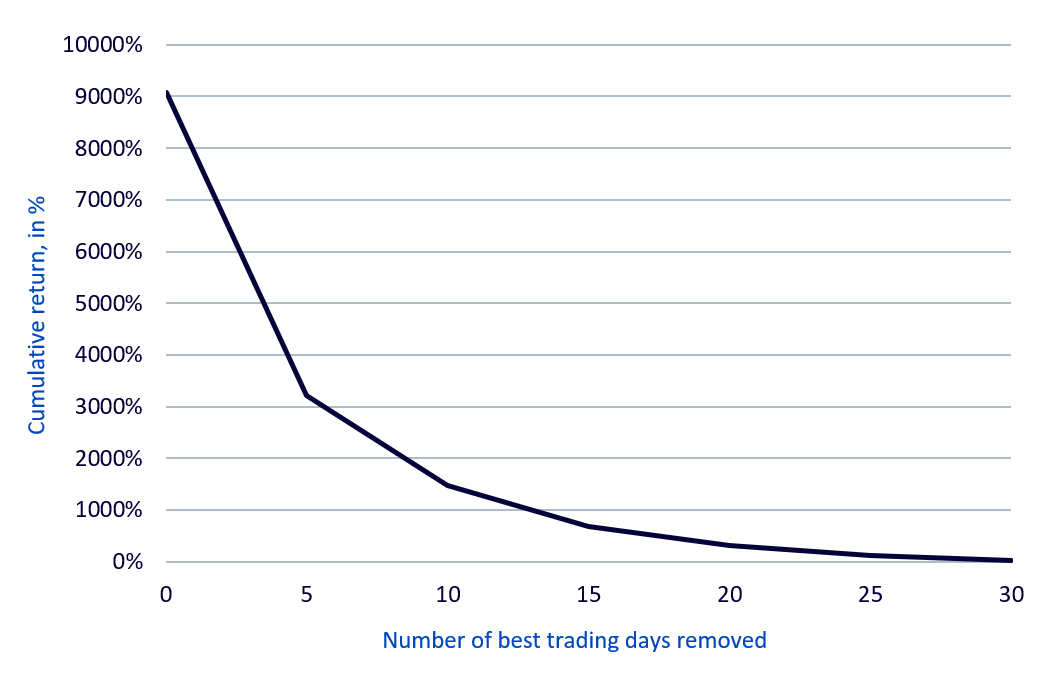
That does not make Bitcoin risk-free.
Far from it.
It means timing perfection may be the wrong standard. Some assets punish investors who try to be too precise.
The QPOS question is not “Is this volatile?”
The better question is:
Are we being paid for the volatility?
The research index as a learning loop
A good research index is not just a list of holdings.
It is a learning system.
Each decision creates a record. Each record creates feedback. Each feedback loop improves the next decision.
Why did we add this asset?
What did we expect?
What were the odds?
What did we miss?
Was the outcome driven by skill, luck, or changing facts?
What should change in the process?
This is where investing becomes less about prediction and more about calibration.
We will still make mistakes.
That is guaranteed.
The goal is not to eliminate errors. The goal is to make them smaller, less emotional, and more useful.
A bad result is not always a bad decision.
A good result is not always a good decision.
The research index helps us remember that when the market tries to make us forget.