

Bitcoin remains one of the most important assets on our research list.
It is liquid.
It is scarce.
It has a growing institutional market structure.
It offers a return stream that is different from traditional businesses and bonds.
But an interesting asset is not automatically an index candidate.
The question is not whether Bitcoin could rise.
The question is whether the current price offers a sufficiently attractive combination of quality, price, odds, and sizing.
Today, the answer is not clear enough.
That is why Bitcoin is not in The Mispriced 25 right now.
The thesis is not broken
Bitcoin’s long-term case remains credible.
Its monetary policy is transparent. The network continues to operate without a central issuer. Mining difficulty increased over the past year, while supply held by long-term holders reached an all-time high of roughly 14.85 million BTC during the second quarter.
That matters.
Long-term holders added approximately 313,000 BTC during a quarter in which the price declined by around 14%.
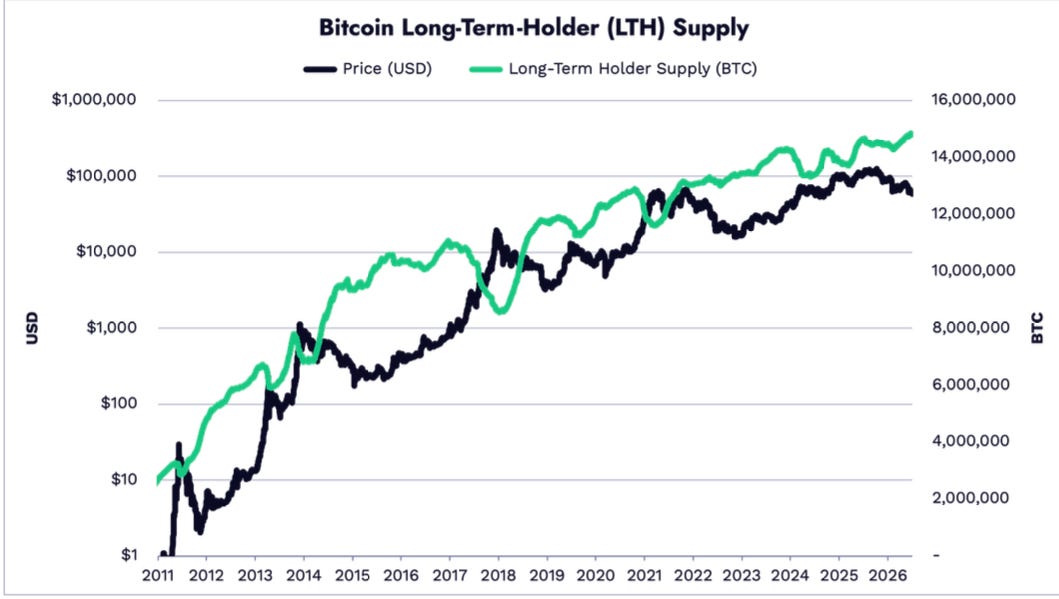
Stronger holders appear to be absorbing supply from shorter-term participants.
This is constructive.
It is not enough on its own.
The current setup is mixed
Bitcoin closed the second quarter near $58,544.
At that level, it was below three important reference points:
Short-term-holder realized price: approximately $70,327
200-day moving average: approximately $75,371
On-chain mean: approximately $76,660
These levels had shifted from support to resistance. Historically, that configuration has been associated with weaker market environments.
At the same time, Bitcoin had not fully returned to the lower cost bases that have often marked more complete resets.
The ArkInvest Report identified realized price near $53,000 and investor price near $49,000. Bitcoin was trading above both.
This leaves an uncomfortable middle ground.
The price has fallen enough to damage momentum.
But it may not have fallen far enough to create a clear margin of safety.
QPOS: The current Bitcoin assessment
Quality
Bitcoin’s network quality remains relatively strong.
The supply schedule is predictable. Liquidity is substantial. Institutional access has improved. Long-term-holder behavior is constructive, and realized volatility has remained near multi-year lows despite the decline.
But quality is not uniformly improving.
Active ownership and transaction volume weakened. Miner revenue was under pressure. The broader market still depends heavily on confidence, liquidity, custody infrastructure, and regulation.
Bitcoin may be a high-quality monetary network.
It is not a stable cash-generating business.
That distinction matters.
Price
Bitcoin is difficult to value because it does not produce cash flow.
There is no earnings yield, free-cash-flow model, or book value to anchor the analysis.
Price must be assessed through adoption, scarcity, network activity, positioning, liquidity, cost bases, and the expectations already reflected in the market.
At roughly $58,500, the price was below major trend levels but still above the $49,000–$53,000 area associated with deeper historical resets.
That does not make Bitcoin expensive.
It makes the margin of safety unclear.
Odds
The evidence supports several competing outcomes.
Bear case
ETF outflows continue. Treasury companies face higher financing costs. Bitcoin fails to reclaim its major means and moves toward, or below, the $49,000–$53,000 cost-basis range.
Base case
Seller exhaustion limits the downside, but weak marginal demand keeps Bitcoin in a broad consolidation. Price remains volatile without establishing a durable trend.
Bull case
Long-term holders continue absorbing supply. ETF flows recover. Bitcoin reclaims its short-term-holder cost basis and major trend levels, confirming that the correction was a reset rather than the beginning of a longer contraction.
The current expected value may be positive over a long horizon.
The near-term distribution remains too wide for a high-conviction index position.
Sizing
Bitcoin’s volatility is lower than in previous cycles, but it remains high relative to most assets considered for The Mispriced 25.
It also carries risks that are difficult to model:
Regulatory change
Custody and operational failures
Market-structure stress
Leverage embedded in treasury companies
Dependence on marginal liquidity
Technological and security risks
A Bitcoin position would therefore need to be smaller than a typical index position unless the entry price and thesis strength improved materially.
Sizing cannot repair a weak setup.
It can only limit the damage if the thesis is wrong.
What would put Bitcoin back into consideration?
There are two credible paths.
1. A better price
Bitcoin trades into or below the $49,000–$53,000 cost-basis region, selling pressure becomes exhausted, and the network remains healthy.
This would not create an automatic index entry.
It could create a more attractive asymmetry: lower expectations, clearer downside reference points, and a larger potential margin of safety.
2. Better confirmation
Bitcoin stabilizes and reclaims key levels between roughly $70,000 and $77,000.
At the same time:
ETF flows turn consistently positive
Treasury-company financing stress declines
Network activity improves
Long-term-holder supply remains firm
The recovery is not driven by excessive leverage
This would mean paying a higher price.
But it could improve the odds that the trend and demand structure have genuinely repaired.
The cheapest entry is not always the best entry.
The goal is not to capture the exact bottom.
The goal is to enter when the relationship between downside, upside, and evidence becomes attractive.
The decision
Status: Watchlist.
Bitcoin is not excluded because the long-term thesis has failed.
It is excluded because the present setup does not yet offer enough clarity across price, odds, and sizing.
That could change quickly.
Until then, doing nothing is also a decision.
The Mispriced 25 is not designed to own every important asset.
It is designed to hold 25 assets where the evidence, expectations, and downside create a sufficiently attractive research case.
Bitcoin may qualify again.
It does not qualify today.